Tag Archives: TraditionAndTogetherness

Bidding Adieu to Maa: Dashami

Durga Puja is not just a festival—it is an emotion. It is five days of togetherness, rituals, food, and celebration that culminate in a bittersweet farewell on Dashami. This year, as always, the last day carried the weight of both joy and sorrow.


The Morning Frenzy

The day began early. Perhaps it was the thought that Maa would soon leave us that stirred everyone out of bed early. The morning saw the house buzzed with unusual urgency.

As part of the ritual, a yellow cloth is cut to make áparajita bands to be tied at the end of the day. But the cloth was nowhere to be found. We searched every corner, a mild panic building, since on Dashami most shops remain shut. Just when we thought we’d have to improvise, one cousin dashed to the market nearby—and to everyone’s relief, found one open shop. The yellow cloth was procured, and with it, calm returned.


Preparing to Welcome and Bid Farewell

Tradition has it that on Dashami, Maa is treated like a daughter leaving her paternal home. The customs reflect this deep symbolism.

A boron thala was readied—filled with sindoor, dahi, dhan, durba, paan, and sweets. What made the moment especially endearing was watching a mother-in-law and daughter-in-law prepare it together, bridging generations through ritual.

Meanwhile, my sister-in-law reminded us that the kolabou from the puja mandap would be brought inside. A spot had to be decorated with rangoli. Not being the best rangoli artist, I began hesitantly until one of my nieces joined me. Together, we managed something that, if not perfect, passed muster with cheer.


The Last Arati and Bhog

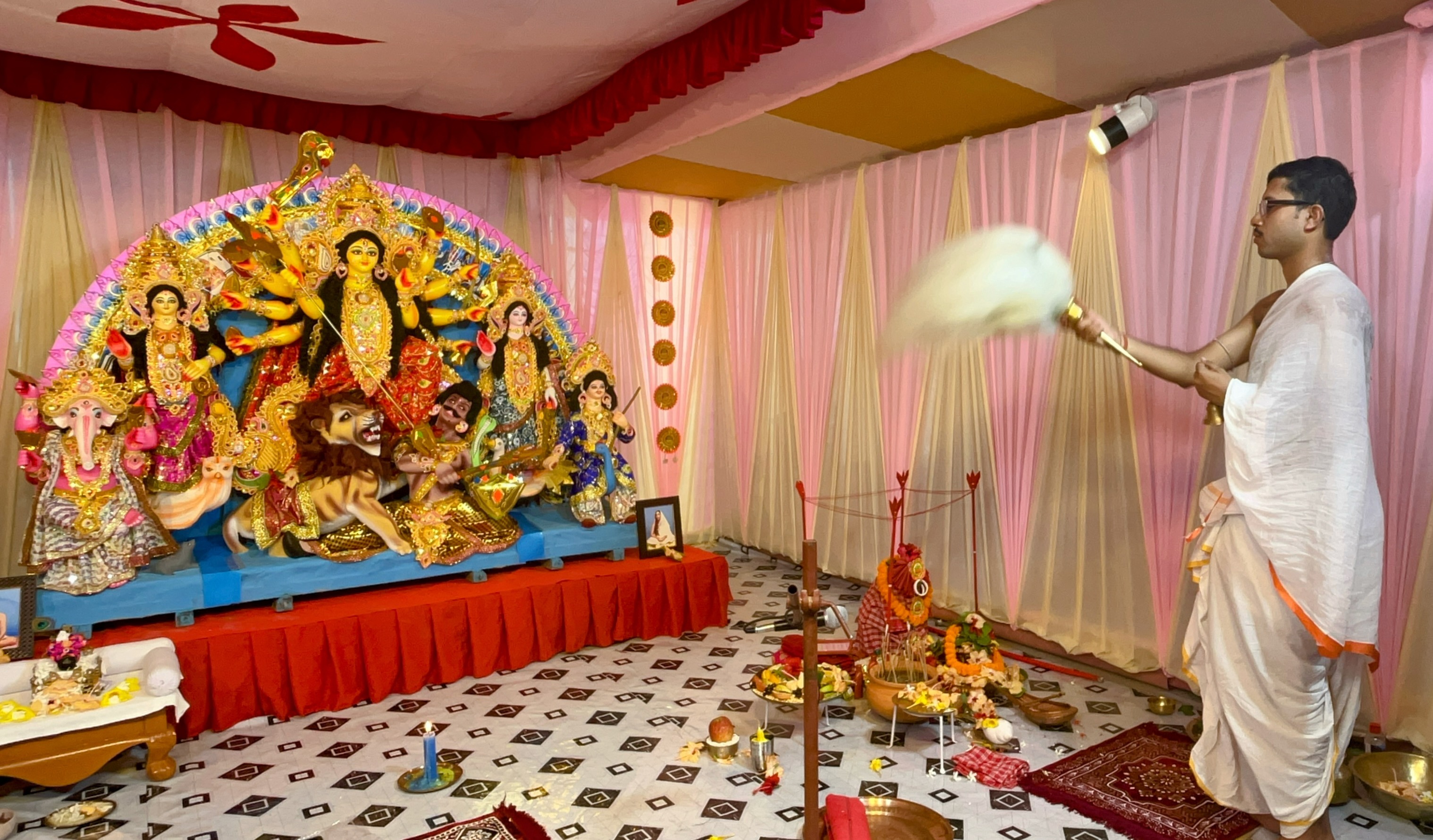
At the mandap, the final arati took place, filling the air with conch shells, incense, and the mingled emotions of farewell. The bhog of the day was humble yet deeply comforting—siddho bhaat, rice with boiled vegetables, served with ghee and chura, dahi, and gur.

This meal carried a personal memory too. Growing up, whenever we returned from holidays from my maternal uncle’s house, my mother would like to eat siddho bhaat, believing it was the best way to reset the body. Eating it again on Dashami felt like a return to roots.

Before the farewell, a large mirror was placed in a bowl of water, positioned so that Maa’s face was reflected. We were asked to bid adieu as we looked into the reflection. The symbolism was powerful, and the moment left everyone quiet, reluctant to let go.


Sindoor Khela and Procession to the River

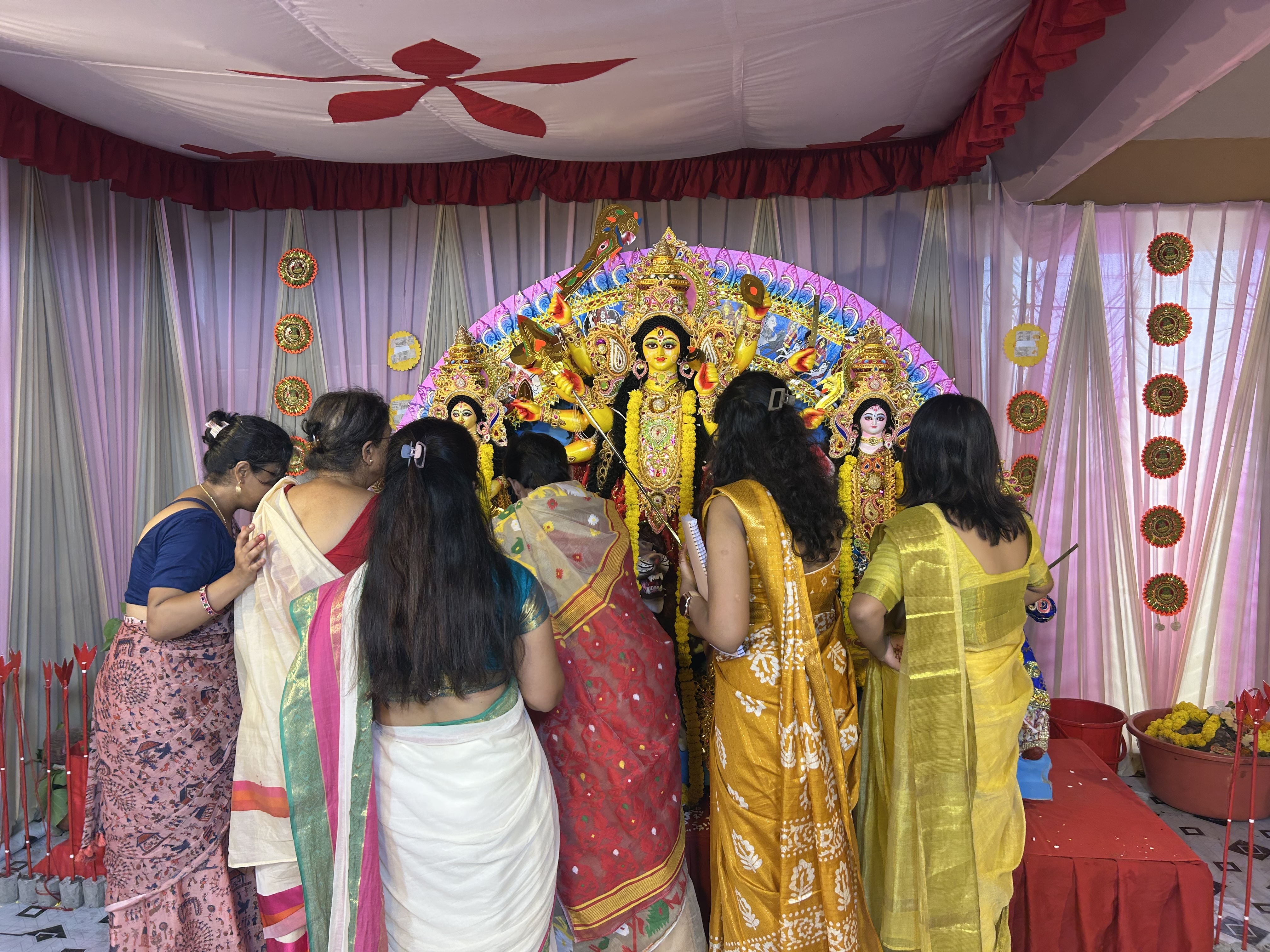
Soon after, the mood shifted to festivity. Married women gathered for sindoor khela, smearing vermillion on each other in a celebration of womanhood, prosperity, and joy. Laughter rang out, faces turned red with sindoor, and the air carried a lighter note.
The kolabou was ceremonially brought inside, and preparations began for visarjan. The idols were carefully loaded onto a mini truck, followed by a convoy of vehicles. Children, especially, were excited at the thought of walking to the Barak River, three kilometers away.

But the skies had other plans. As we left, a drizzle began, soon turning into heavy rain. A tarpaulin was pulled over the idols, and we scrambled for cover. Eventually, many of us found shelter in the vehicles, though the rain and the rush meant the journey became chaotic. Yet, in its own way, this chaos carried its charm.


At Sadar Ghat: The Immersion

After nearly an hour and a half, we reached Sadar Ghat, the town’s main immersion site. Trucks rolled in one after another, and idols were transferred onto wheeled platforms before being taken to boats.

The sight was surreal—the rhythmic movement of idols, the chants of “Bolo Durga Mai ki… Jai!”, the synchronised immersion as each idol was pushed gently into the river. Everything happened with clockwork precision, and just like that, Maa was gone.

There was not a dry eye as we turned back.


Holding on to What Remains

Durga Puja is fleeting, but its aftertaste lingers. In a day or two, everyone will return to routine life, schools and offices, deadlines and duties. Yet these five days of togetherness, the shared meals, laughter, rituals, and even the frantic searches for a missing cloth, are memories that remain etched forever.

As we bid adieu to Maa, we carry with us the assurance that she will return again next year, and until then, her blessings stay with us.

Maa Comes Home: Saptami

After two days of endless running around, I slept like a log. No one woke me up—or perhaps I was simply too tired to hear anything. When I finally opened my eyes, I realized with a jolt that the crucial ritual of Kolabou Snan was to take place that morning. Had I overslept and missed it?

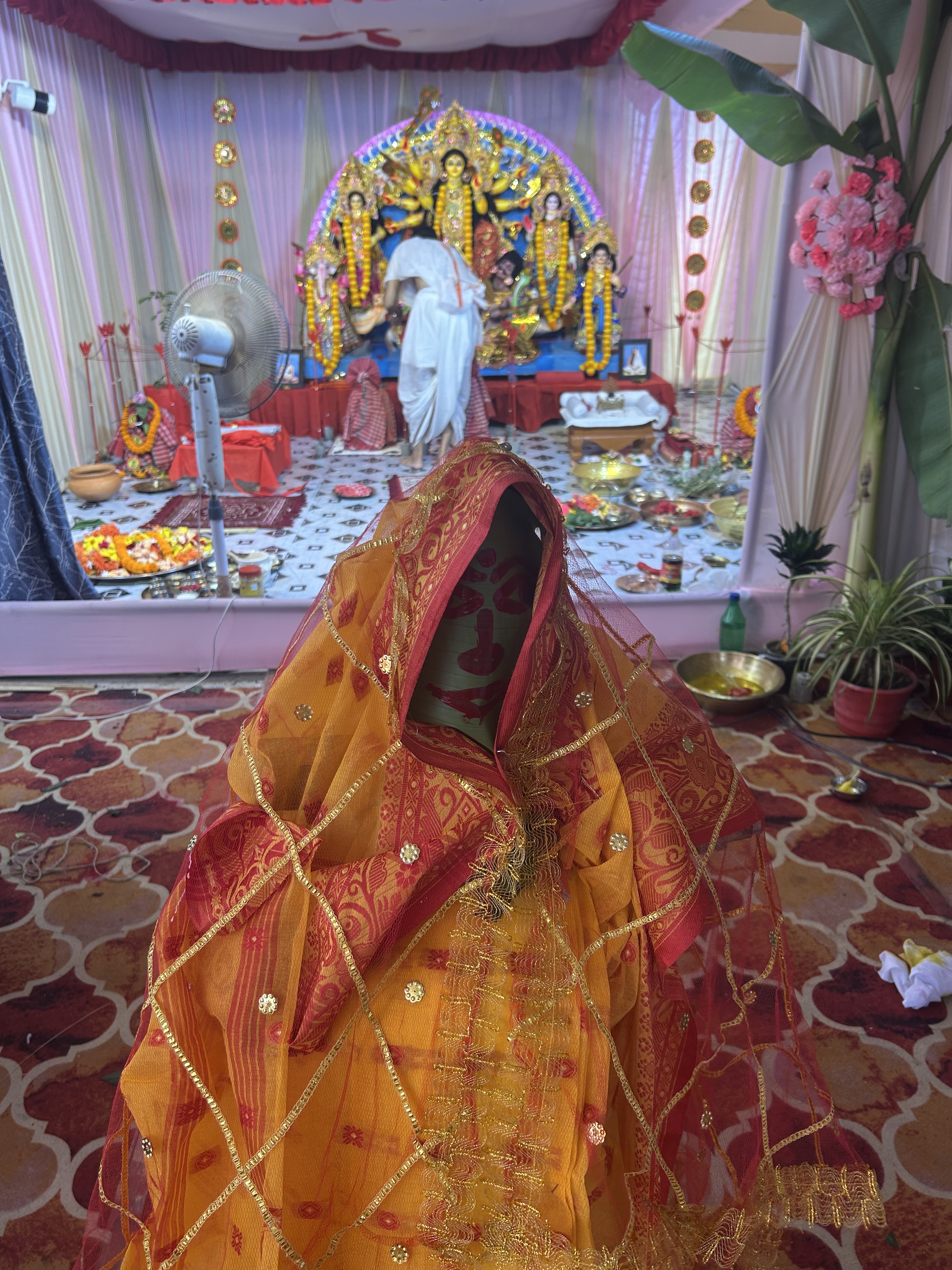
Half in panic, I rushed towards the puja mandap, only to find that the ritual was just about to begin. Relief washed over me. This is the very first ritual of Saptami—the bathing of the kola bou, the banana plant that is ceremoniously transformed into a symbolic form of the Goddess.

With elaborate chanting, the kola bou was bathed. What fascinated me most was the next step—draping a saree around the plant. I don’t think I had ever seen this ritual so closely before. A face was drawn on a fresh banana leaf (kola pata), carefully placed, and the saree was adjusted. With the aanchal gracefully covering her head, there stood before us a new form of Maa, so simple yet so divine.

But there was little time to linger—pushpanjali was at 10 a.m. and the house was abuzz with last-minute preparations. My two nieces, brimming with excitement, had decided they must wear sarees for the offering. The problem? They had no idea how to drape one. One of my uncles insisted that his granddaughters must do pushpanjali in saree, and suddenly I found myself cast in the role of saree-dresser. Their hurried, uneven attempts soon gave way to my hands pulling pleats and adjusting pallus—just as my elders once did for me. It was one of those tender, everyday moments that define a Bengali household.

The day flowed on with arati, bhog, laughter, and photo sessions. But the evening held a special thrill—the dhanuchi nach. A clay pot was lit, smoke curling upwards in the mandap, the rhythmic beat of the dhol filling the air. As a child, I never had the chance to try the dhanuchi nach, living too far from community pujas. This time, something inside me stirred. I picked up the earthen pot, still uncertain of my two left feet. Yet, in front of Maa, hesitation melted away. The beat took over, and before I knew it, my steps found rhythm, my body moved in sync with the drum, and I was dancing—smoke, fire, and devotion all mingling in that fleeting moment.

Saptami was a day of rituals, but more than that, it was a day of family, of shared laughter, of discovery and tradition blending seamlessly. It reminded me that Maa doesn’t just come home in the idol—she arrives in these lived moments of togetherness, joy, and courage.

Indeed, Maa does wonders.

Maa Comes home: Sashti


The day began at sunrise. My brother woke us up, reminding us that Chandi Puja was scheduled to start at 6 a.m. The quiet of the morning soon gave way to the rhythmic chants of shlokas, and with that the day unfolded into one steeped in devotion, tradition, and togetherness.

The Young Purohits: Tradition in New Hands
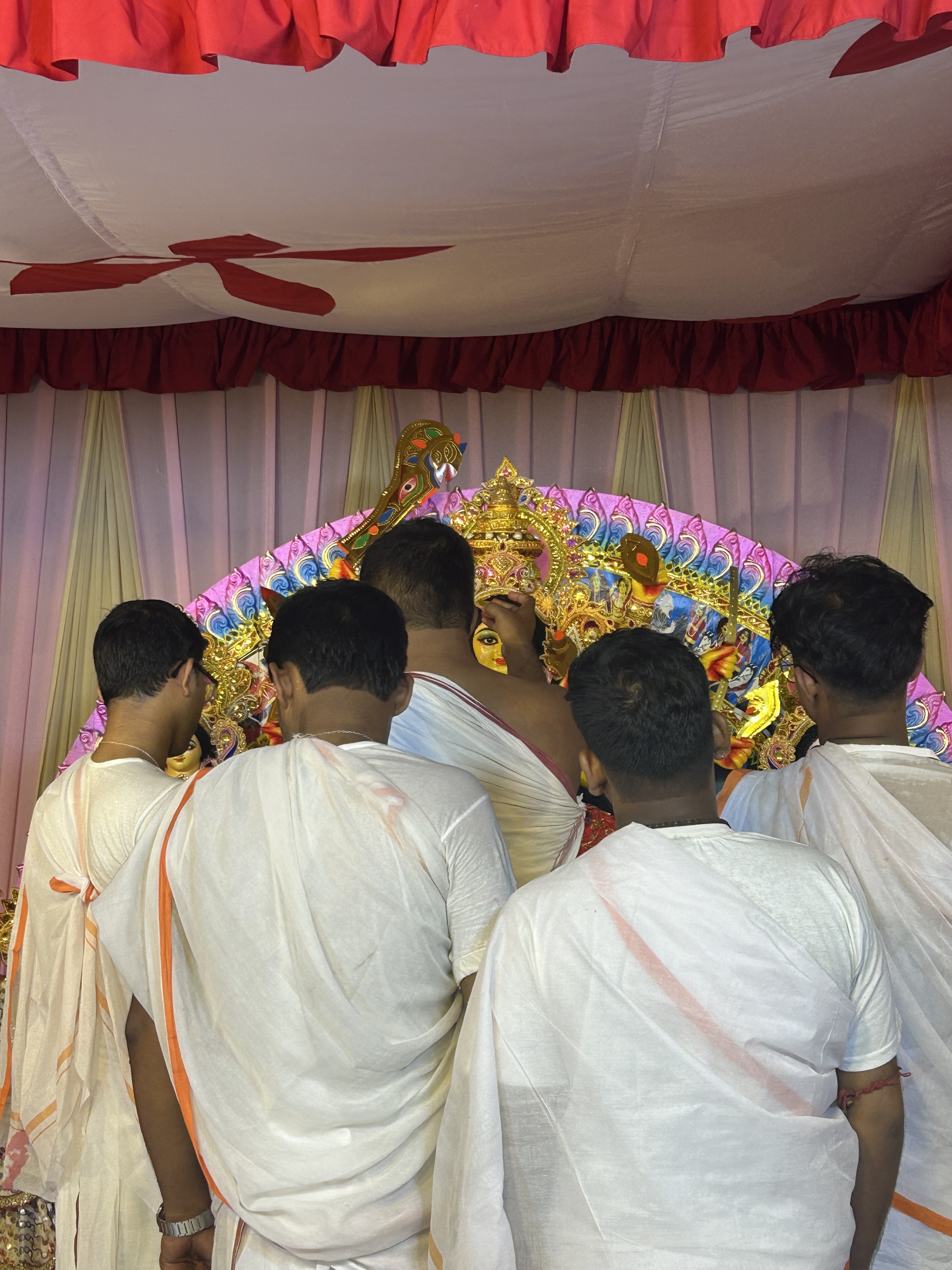
This year’s puja carried a unique touch — the rituals were conducted by a group of young purohits in their twenties. It was both heartening and reassuring to watch tradition being carried forward so earnestly. What struck me most was a young Purohit, a student doing his masters, reciting the Chandi Path with impeccable diction and clarity.

As I listened, memories came rushing back, of my childhood, when my eldest uncle would perform the Chandi Path. That sound had long been my only reference for this sacred recitation. Watching the next generation step into that role was a reminder of how rituals survive through continuity, transforming into lived heritage.

The Sacred Offering: Bhog-er Prasad
Around noon, it was time for the bhog-er prasad. This is not a meal in the conventional sense but a divine mash-up of everything offered to Maa — from lemon to Anna bhog to payesh. The mix, though unusual, always tastes heavenly, not only for its flavors but because it is sanctified as Maa’s blessing.

Evening Rituals: Sashti, Kola Bou and Pran Pratistha
The evening brought with it the rituals of Sashti and the preparation of Kola Bou, symbolizing the nine sacred plants or Nabapatrika. Kola Bou reinforces our eternal connection with nature, reminding us that the festival is as much about celebrating divinity as it is about honoring the earth that sustains us. This was followed by the elaborate ritual of Pran Pratishtha, when life is invoked in the idol.

Beyond the Mandap: The Joy of Togetherness
But puja is never just about rituals. It is about everything that happens around the rituals — the pranks, the eagerness to dress up, slipping back into the cool AC room after braving the heat of the mandap, and the endless adda sessions that spill over from morning to night. These moments are what bind families and generations, adding warmth to the devotion.

A Day to Remember
Chandi Puja is said to be an integral part of Durga Puja, yet for me it has always carried the memory of one elder’s voice, one family moment. Experiencing it in this way — led by the young, shared in the company of many, and accompanied by laughter and joy — made the day unforgettable.

Durga Puja is not just worship; it is living culture. It is where tradition meets memory, devotion meets joy, and Maa comes home in a thousand little ways.