Do places choose us, or do we choose them? I’m not a psychic, but that question kept circling in my mind as I drove down to Vrindavan. I am not someone who visits temples often—especially the crowded ones that feel more like fairs than places of prayer. So, why was I headed there?
Diwali falls on Monday this year, making it a long weekend. Having just returned from a Durga Puja break, I had no plans. But as friends and colleagues began sharing theirs, the idea of doing something started tugging at me. I almost decided on Benaras, until I realized that if I went there, I would have to travel on Diwali day just to reach the office by Tuesday. That didn’t feel right.
And so, without much deliberation, the plan seemed to make itself. Saturday morning, coffee in hand, I casually searched for short drives from Delhi—and just like that, Vrindavan and Mathura appeared on my screen. A few clicks later, the hotel was booked. By Sunday morning, I was on the road.
Leaving Delhi and Gurugram behind, I cruised along the Delhi–Vadodara–Mumbai Expressway before turning onto the Western Peripheral Expressway and then NH44. The road stretched out smooth and bright, flanked by bursts of bougainvillea in pink and orange. There was even a man with his pet monkey performing tricks by the roadside. The blanket-sellers confirmed what I already felt in the breeze—that summer had finally loosened its grip.
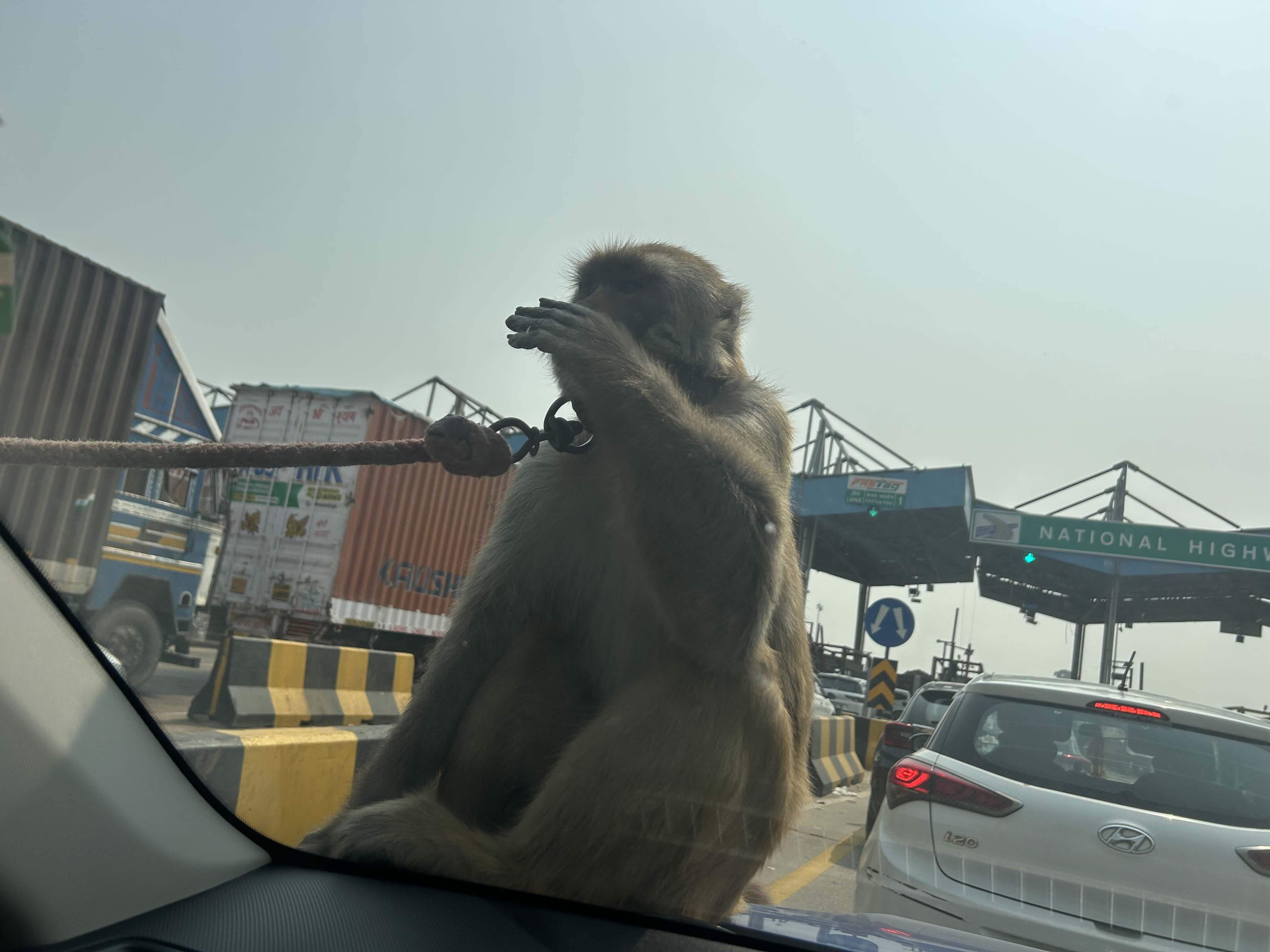
Less than three hours later, I reached Vrindavan. My first greeting: “Radhe Radhe.” Here, Krishna is not just worshipped—He is woven into every breath, every sound, every conversation.

After a short rest, I took an e-rickshaw to explore. My first stop was the ISKCON temple. Before I got down, the driver advised me to remove my glasses—Vrindavan’s monkeys, he warned, were expert snatchers. As if to prove his point, one sat nearby watching me intently. I quickly slipped my glasses into my purse—a precaution that became routine for the rest of the day.

From ISKCON, I headed toward Kesi Ghat, stopping at Nidhivan on the way.
According to legend, Nidhivan is where Lord Krishna performs his Raas Leela with Radha each night, which is why the grove is closed to visitors after dusk. It is said to hold 16,000 kinds of tulsi plants. My rickshaw driver suggested hiring a guide, but I declined—only to find one walking beside me moments later. After some friendly persuasion, I agreed, and I’m glad I did; the lanes were narrow, winding, and easy to get lost in.

The guide led me through a series of small temples, each echoing with the soft rhythm of bells and chants. One was dedicated to Swami Haridas, a revered devotee of Krishna. By the time we reached there, I had run out of small notes. When I offered a hundred-rupee note instead, the priest smiled and handed me not only charanamrit but also a besan laddoo. I couldn’t help but laugh as I walked away, nibbling on the sweet.
Another memorable stop was the Vrindavan Bihari Dauji Maharaj Temple, its walls covered with marble plaques dedicated by devotees—including one from Lalu Prasad Yadav and Rabri Devi.
As evening approached, I made my way to Kesi Ghat. I’ve always known the Yamuna as a polluted river, so it was a pleasant surprise to see it in better shape. The sky glowed gold and lilac as people around me floated tiny diyas in the water. I joined them, releasing one that drifted gently downstream—a small offering of light.

Nearby, preparations were on for the Sandhya Aarti. I waited for over an hour, watching lamps being arranged, the air thick with anticipation. At one point, the priest scolded a woman for using a plastic plate under her diya. “If we think only of faith and not of nature,” he said, “then our prayers will bear no fruit.” His words struck me as profoundly true—for perhaps that’s the only way India’s rivers can be saved.

After another half hour of waiting, the Aarti still hadn’t begun, and I finally decided to return.
On the way back, the soundscape of Vrindavan surrounded me—kirtans from nearby temples, devotees quietly counting rosaries as they walked, and everywhere, the soft greeting of “Radhe Radhe.”
In that moment, I realized: perhaps we don’t choose places. Maybe they choose us when we need them most.
 Jajabor