It was a small news item, years ago, that first caught my attention — a report on an eighteen-armed sculpture of a mother goddess in a place called Pilak. The name lodged itself in my mind, stirring curiosity. I tried convincing colleagues at work to join me on a trip to see it, but the plan never took off. Worse, a few went on their own during a visit to South Tripura and returned claiming there was no such sculpture at all.
So Pilak had to wait.
Two years later, my mother came visiting. She, like me, has an appetite for history. Suddenly, I had the perfect travel companion. We decided to spend a Saturday exploring the Buddhist heritage of Tripura, sculpture or no sculpture.
First Stop: Maharani Pagoda
Flipping through the state tourism brochure, we decided to start from the far south — the Mahamuni Pagoda at Manubankul village in Sabroom subdivision, 134 km from Agartala. We had also read about an old monastery nearby, but despite asking locals, we couldn’t find it. The day was hot, humid, and off to a slow start.
The pagoda, when we finally stood before it, was less impressive than its photographs. I couldn’t help remembering my colleagues’ disappointment and wondered if our trip was ill-fated. But neither of us was ready to give up.

The pagoda, which looks more beautiful in photographs

Monks take their vows here.
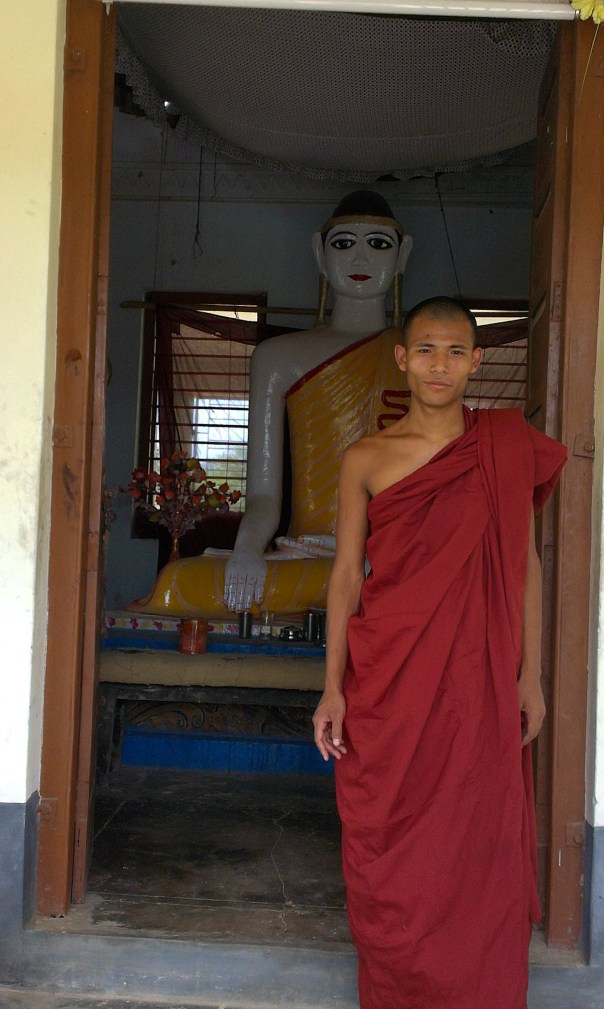
Met this Chakma Monk from Bangladesh
Pilak — Where Faith Meets Preservation
Our driver, to my relief, knew exactly where Pilak was. This archaeological site in Belonia subdivision has been revealing treasures since 1927 — sculptures and structures tied to both Buddhism and Hinduism, dating back to the 8th–12th centuries.
Once part of the Samatata kingdom in historical Bengal, Pilak’s finds link it to other great Buddhist sites like Mainamati and Somapura Mahavihara in present-day Bangladesh. Its artifacts bear the marks of Bengal’s Palas and Guptas, the Arakan style of Myanmar, and indigenous craftsmanship.
Excavations by the Archaeological Survey of India in the 1960s uncovered brick stupas and large stone sculptures of Avalokiteśvara and Narasimha, as well as numerous Hindu deities like Shiva, Surya, and Vaishnavi. Pilak is remarkable for the diversity of Buddhist traditions it reflects — Hinayana, Mahayana, and Vajrayana.
Some finds are especially striking:
-
Avalokiteśvara — now at the Tripura Government Museum in Ujjayanta Palace.
-
Goddess Marichi — an 8th–9th century Mahayana-Vajrayana icon, now worshipped in a Hindu temple known as Vasudev-badi.
-
Chunda — an 18-armed figure from the 8th–9th century, now revered as Raja Rajeshwari.
-
A stupa from Sundari Tilla — dating to the 11th century, echoing the Pala style.
-
Sun God Surya — riding his chariot of seven horses, from the Sagardheba mound.
At Pilak, faith often redefines history. Sacred icons have been moved from excavation sites to local temples, where they are worshipped in forms quite different from their original context.


Some glimpses of Pilak


A ‘Seshnag’ sculpture, which is worshiped as Shiva in this temple, is almost next door to the above archaeological site
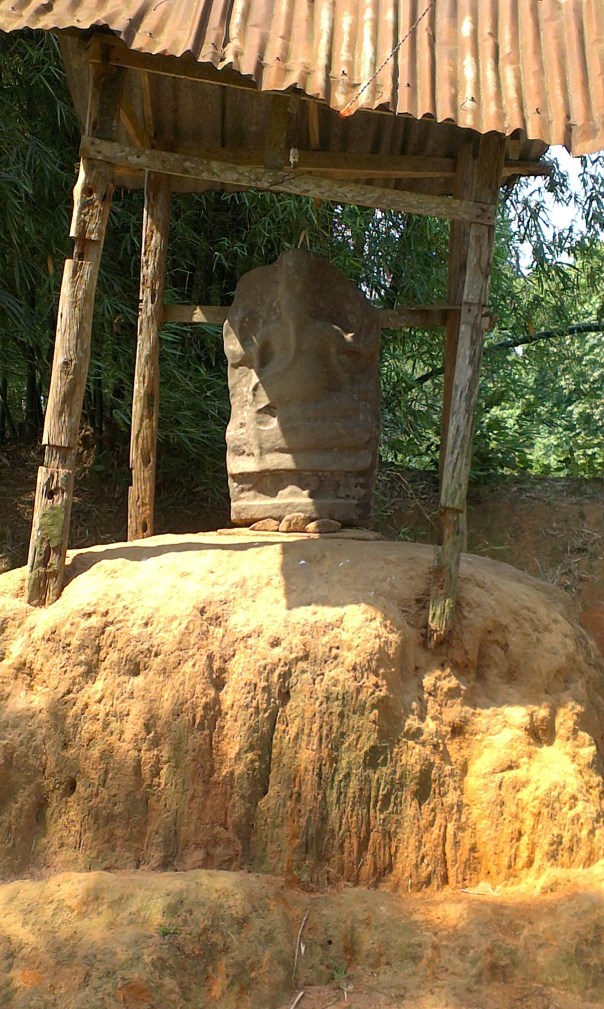
A Ganesha Sculpture kept almost open in the nearby village


The eighteen handed goddess Tara in Raja Rajeshwar Temple
Boxanagar — A Forest Yields a Secret
Our final stop was Boxanagar in Sonamura subdivision, West Tripura — a relatively recent discovery. Here, the ruins of a brick-built structure emerged after a patch of forest was cleared near the Bangladesh border. Locals thought it was a temple of Manasaa, the snake goddess.
In 1997, the ASI unearthed a Buddha sculpture, confirming the site was once a Buddhist temple, possibly active from the 8th to 12th centuries. Archaeologists believe it played a role in spreading Buddhism in the region.


A much better preserved site at Boxanagar
Home with History
By evening, we were back in Agartala, tired but satisfied. The day had been a journey not just through distance, but through centuries — an exploration of how faith, history, and heritage intertwine in the quiet corners of Tripura.
 Jajabor