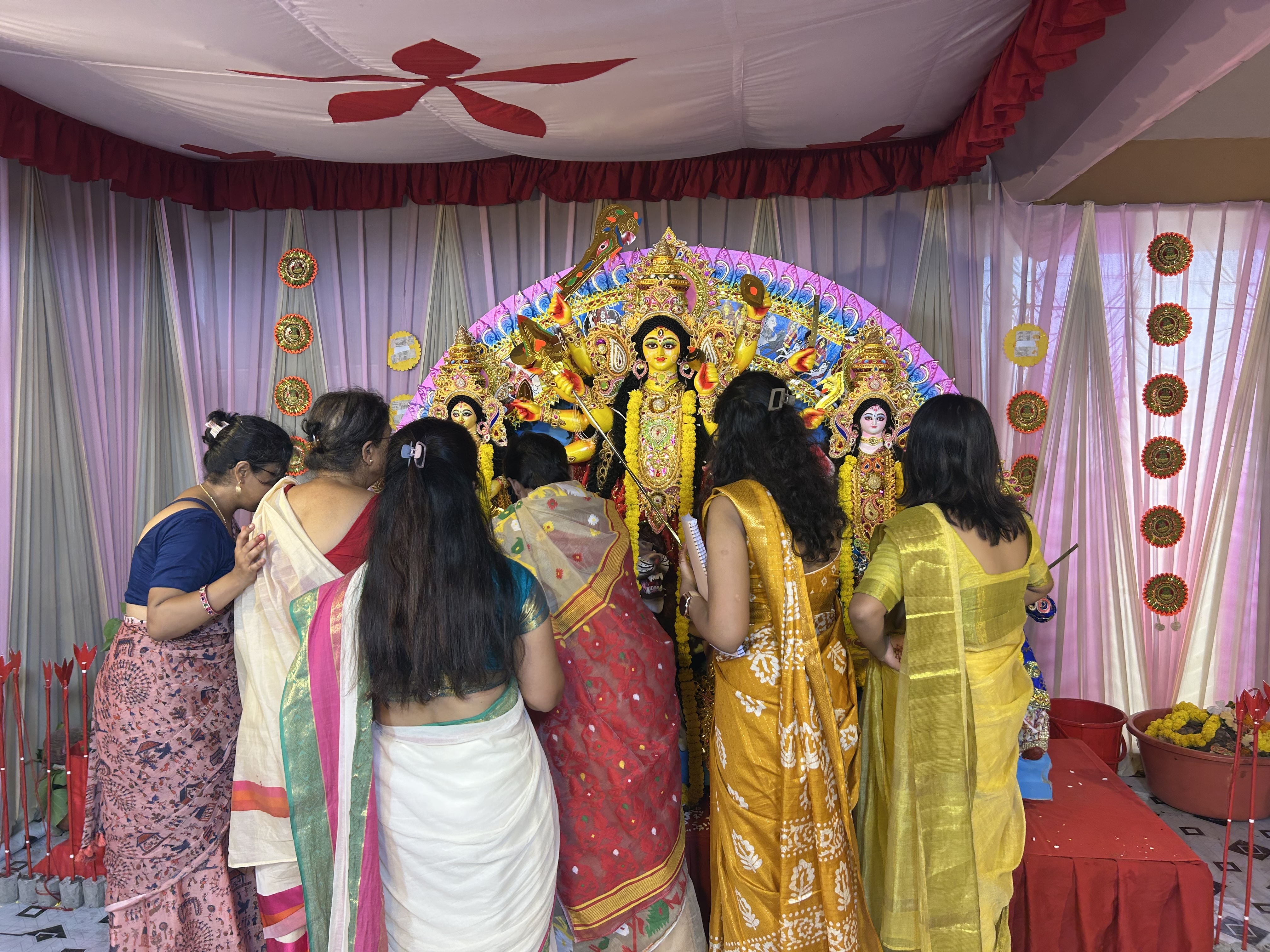
Durga Puja is special for every Bengali. But this year, it turned extra special. This year, Maa came home.
What does it feel like when Maa comes home?
It feels like months of planning and tons of shopping. It feels like chaos that somehow turns into joy. It feels like generations coming together—airport meetups filled with hugs, endless food, dressing up in silks and kurtas, and continuous adda sessions that carry through the night.
For me, Durga Puja has always been a community festival. My most vivid memory was from Kolkata, when our apartment complex organised the Puja—collective, chaotic, and deeply rooted in togetherness. I had only read about ghar-er pujo—Durga Pujas held at home—or seen them recreated in films. So when my cousin decided to organise one this year, I knew I had to be there.
And let me tell you, to call it “challenging” is an understatement. Durga Puja is often described as a Rajashik puja—one that kings performed.
I woke up before dawn, caught connecting flights, and landed in the sweltering heat and humidity of Silchar. By evening, it was Panchami—the fifth day of Navratri—and time for the first ritual, Pran Pratishtha, the ceremony where life is invoked in the idol.
The evening was filled with frantic activity when a power cut threatened to plunge everything into darkness. Out came our mobile phones, lighting up the puja mandap in a glow both modern and makeshift. But Maa, it seemed, wasn’t amused by this arrangement. The power cut lingered, and finally, generators whirred to life, bathing the mandap in light once more. Just when we thought we would melt away in the humid heat, the electricity returned—as if Maa had decided it was time to ease our troubles.
And then it began. The sounds of the conch, ulu, and dhak filled the air, announcing what our hearts already knew—
How is it that as technology advances, the quality of life seems to decline? This thought weighed heavily on my mind as I stepped out into Delhi’s smog-filled morning. Dull. Dreary. Suffocating. Each winter, the capital transforms into a gas chamber, and each year’s promises of cleaner air evaporate faster than the smog settles back in. With my quota of casual leaves exhausted, and thus, my dreams of a temporary escape, frustration clung to me like the haze itself.
Just then, a message flashed: an INTACH heritage walk in the Northern Ridge. A chance to breathe history, if not fresh air. That it was led by a master storyteller Ratnendu Ray, the idea was inviting. I signed up.
Sleep, however, conspired against me. I woke late, rushed through the morning, and hastened toward Kamla Nehru Ridge Park or Bonta Park, frantically searching for Gate No. 1. Inside, a short walk led to Flagstaff Tower, where the group awaited.
On the way, monkeys ambled fearlessly across the path as if they owned it. Morning walkers clutched sticks as insurance. Memories of Vrindavan’s notorious simian bandits resurfaced. Would my glasses survive this walk? But the monkeys only cast indifferent glances my way.
Where History Watches the City Below
The Northern Ridge rises above Shahjahanabad or Purani Dilli, one of Delhi’s seven historical cities. Flagstaff Tower, once a watchpoint, sits at its highest elevation. Today, it is surrounded by trees, but this greenery is not ancient; it is the product of three rounds of afforestation before independence. Hard to imagine that this tranquil patch of forest was once a British encampment during the 1857 war.
Our walk began with stories of the siege, of smoke and cannon fire, where parakeets now flutter, and a glimpse into early war journalism. Felice Beato, the pioneering war photographer, had captured this very landscape scorched by battle. The Delhi Urdu Akhbar had tried to shape public sentiment, reinforcing Bahadur Shah Zafar as the symbolic leader. The tools change, but the media’s role in nation-building and narratives remains constant.
We learned of Brigadier General John Nicholson, the strict Irish officer who commanded British forces from August 1857 till his death in September 1857. His reputation in the North-West Frontier was so imposing that he inspired a cult — his followers, the Nikal Seynis, treating him almost as divine. History has its ironic humour. Interestingly, the cult is said to have lasted into the 21st century.
Ruins, Remnants, and the People Who Remember
Next came Chauburji Masjid — a 13th-century mosque once crowned by four domes, now missing half its crown thanks to the bombardments of 1857. With its gates locked, we admired it from the outside. A group of elderly men paused their morning banter to offer us sweets and snacks. Their warmth cut through the wintry chill — and reminded me that heritage isn’t only stone and mortar, but memory and community.
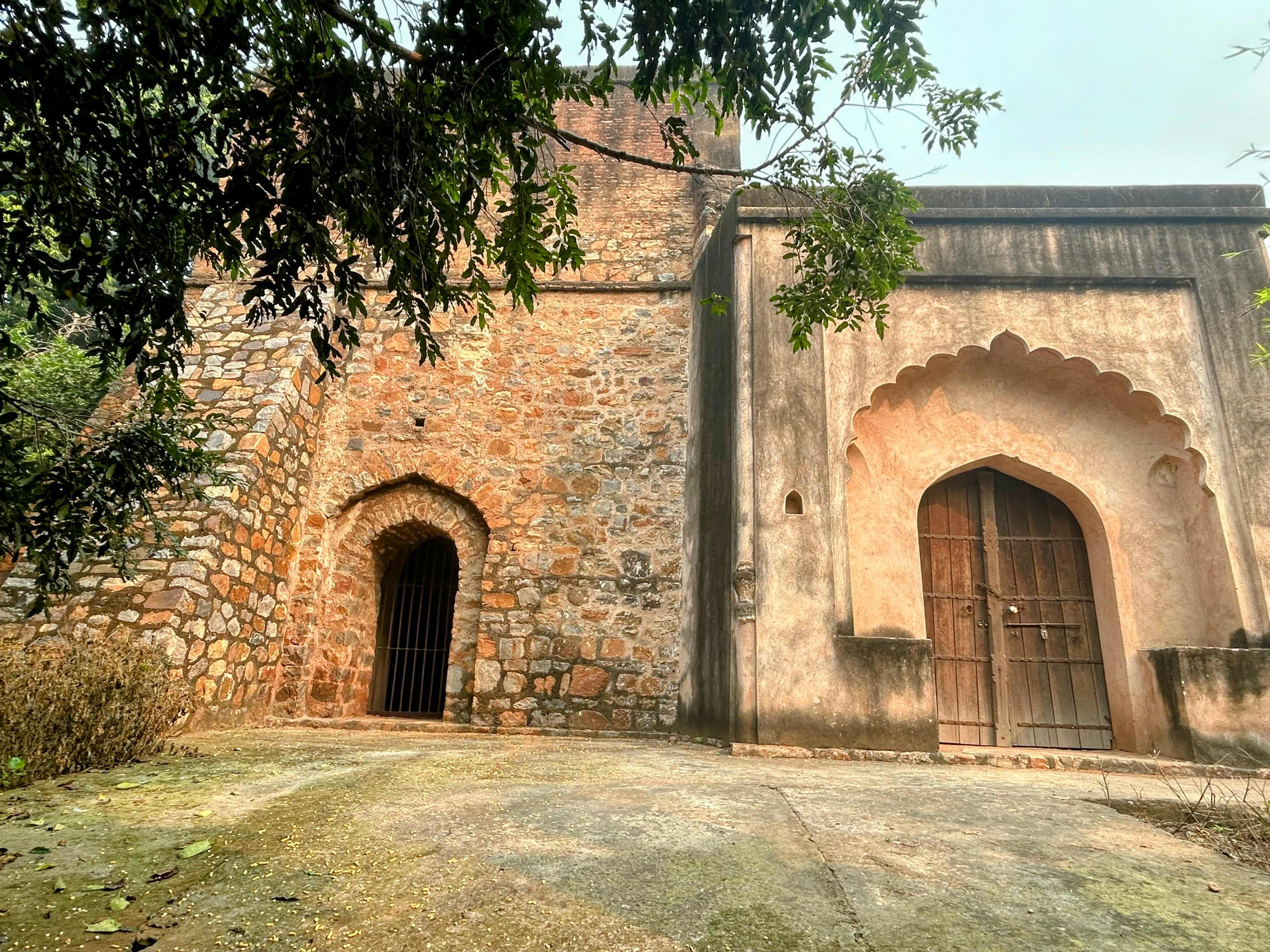
At Pir Ghaib, originally Firoz Shah Tughlaq’s hunting lodge, a lone structure now stands beside Hindu Rao Hospital. A baoli lies neglected nearby. The mansion of Raja Hindu Rao, once a mighty noble’s residence, has vanished and today stands the hospital in its place. Has history been replaced by urgent modern needs? May be not. People who come to the hospital may not know him but his name carries on.
Near the Ashokan Pillar — fragmented by a 1713 East India Company ammunition dump explosion and later restored — the layers deepened. Mauryan ideals. Tughlaq’s passion for collectibles, Mughal drama. British intervention. Modern restoration. Delhi does not erase its history; it compacts it like geological strata.
A Victory Tower, A Shifted Narrative
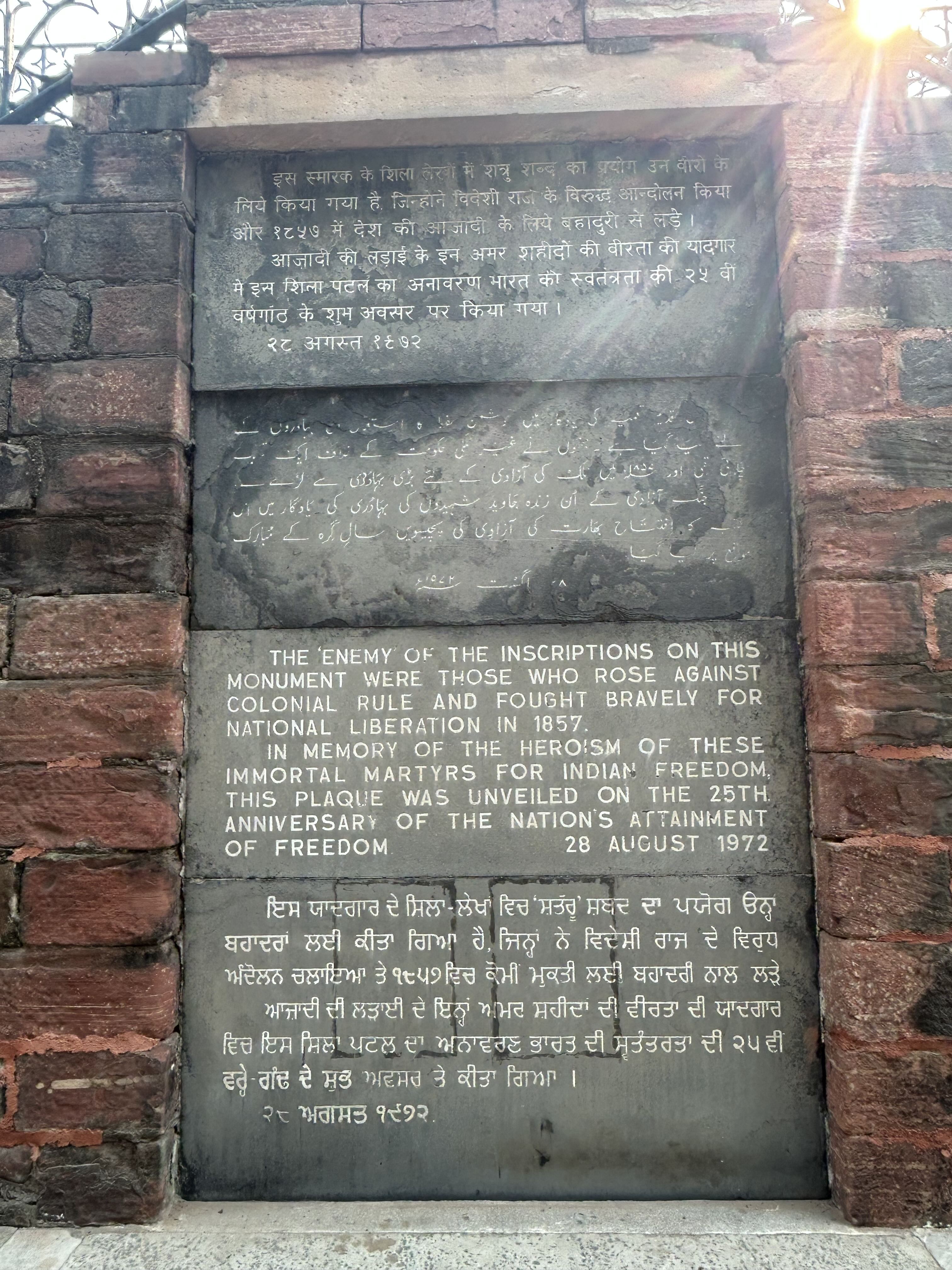
We concluded at the Mutiny Memorial — a Gothic tower celebrating British “victory,” its plaques once labeling Indian freedom fighters as the enemy. After independence, a corrective marker was added: a reminder that the empire’s enemy was India’s fight for self.
Standing there, surrounded by green silence, I reflected on the three hours that had passed. My irritation from the morning now felt smaller. The air may be polluted, but the past here still breathes — vividly, defiantly.
Delhi’s history isn’t merely to be read in books. It rises from the earth, whispers through crumbling walls, lingers in the names of forgotten places. Technology may advance, and quality of life may falter — but what endures are stories. And on the Ridge, the city’s oldest stories still hold their ground.
This morning, I woke up to the crackle of crackers and devotional songs in praise of Chhathi Maiya from the temple next door. Coffee in hand, I watched from my balcony as families offered prayers to the Sun — a familiar scene that somehow always feels new. Later at work, a colleague pressed a small packet of thekuas and fruits into my hand. And as I took that first crunchy bite, I realized something: every year, without consciously seeking it out, I wait for the prasad of thekua. Chhath has always lived at the edges of my life — never my festival, yet always present in my world.
My earliest memory of Chhath is from childhood in Khonsa, Arunachal Pradesh. The town had just one river — a mountain stream that roared during monsoons but, for the rest of the year, became the gathering place for all rituals, from Durga visarjan to Chhath puja. An attendant in my father’s office, originally from Bihar, would bring prasad from the celebrations. His wife — a fierce, unlettered woman with big dreams for her four children — always saved a few extra thekuas for me. She called me “mamoni,” and that love tasted like jaggery and cardamom.
Silchar was different. Predominantly Bengali, yet home to enough Bihari families to light up the banks of the Barak River for Chhath. Some years, thekuas would find their way to our home; other years, the festival passed quietly. But the expectation never dimmed.
Then came work life — new cities, new colleagues, and the same familiar warmth. Wherever I’ve gone, someone celebrating Chhath has always remembered how much I love thekuas. And so, the tradition continues: a festival not mine by birthright, but one claimed through affection, generosity, and food.
It fascinates me how food connects us to cultures beyond our own. Onam isn’t a Bengali festival either, but the joy of a sadya has made it mine. My years in Mumbai sealed my lifelong devotion to modaks during Ganesh Puja. Perhaps that’s the beauty of living in many places — we inherit new traditions not through rituals, but through taste.
Some festivals we are born into. Others adopt us quietly — one delicious thekua at a time.
Day two of my sudden visit to Vrindavan began early. I wanted to make the most of the morning calm and planned to cover Mathura before the crowds swelled. The lanes grew narrower as I neared the Krishna Janmabhumi Temple — ancient walls closing in on centuries of devotion. A man pointed me toward a parking spot and casually suggested taking a guide who, he promised, would show me not just the temple but also Gokul. I agreed.
At the entrance, I had to surrender my bag and all electronic devices. The security rule was firm: no cameras, no phones — no distractions. As I stepped inside, I noticed the resident monkeys, confident and curious. I tightened my grip on my glasses, prompting my guide to chuckle, “Vrindavan ke bandar padhe likhe hain” — the monkeys of Vrindavan are educated; so they snatch glasses!
The temple complex opened into the garbha griha, the Yogmaya Mandir, and finally the Bhagvad Bhawan, where the main idols of Radha and Krishna are enshrined. My early start paid off — I reached just in time for the Mangal Aarti, the first offering of the day that wakes the deity. The chants, the incense, and flickering lamps created a rhythm that seemed to dissolve the boundary between ritual and reverence.
As I stepped out, the domes of the Shahi Idgah Mosque gleamed across the complex — a reminder that Mathura’s story, like India’s, is layered with shared histories.
Across the Yamuna: Gokul’s Cradle of Legends
Though my next stop was supposed to be the Dwarkadhish Temple, my guide gently reminded me of my promise to visit Gokul. We crossed the Yamuna — that mythical river Vasudev once forded on a stormy night carrying baby Krishna.
Gokul’s lanes were humble yet alive with myth. The centerpiece, Shri Nand Mahal, stood adorned with vibrant murals and a cradle for little Krishna. Watching people do so with gentle reverence made the mythology come alive in the most tender, human way.
Dwarkadhish Temple and the Call of Vishram Ghat
Back in Mathura, the Dwarkadhish Temple awaited at the end of another labyrinth of lanes. A rickshaw helped me glide through the festive chaos — Diwali shoppers, sweet sellers, and vendors adding color to the air. Inside the temple, serenity prevailed. I had a clear darshan of the idol and a brief, grounding silence amid the bustle.
Just a few steps away lay Vishram Ghat, the sacred stretch where Krishna is believed to have rested after slaying Kansa. My guide seemed mildly disappointed when I declined a puja, preferring instead to watch life unfold — priests lighting lamps, pilgrims taking a dip in the Yamuna, and boats plying. When I pulled out my phone for a photo, he sighed, “Aajkal sab picnic ban gaya hai.” I smiled quietly and said nothing. Sometimes, observation is devotion too.
Vrindavan Again: The Marble Glow of Prem Mandir
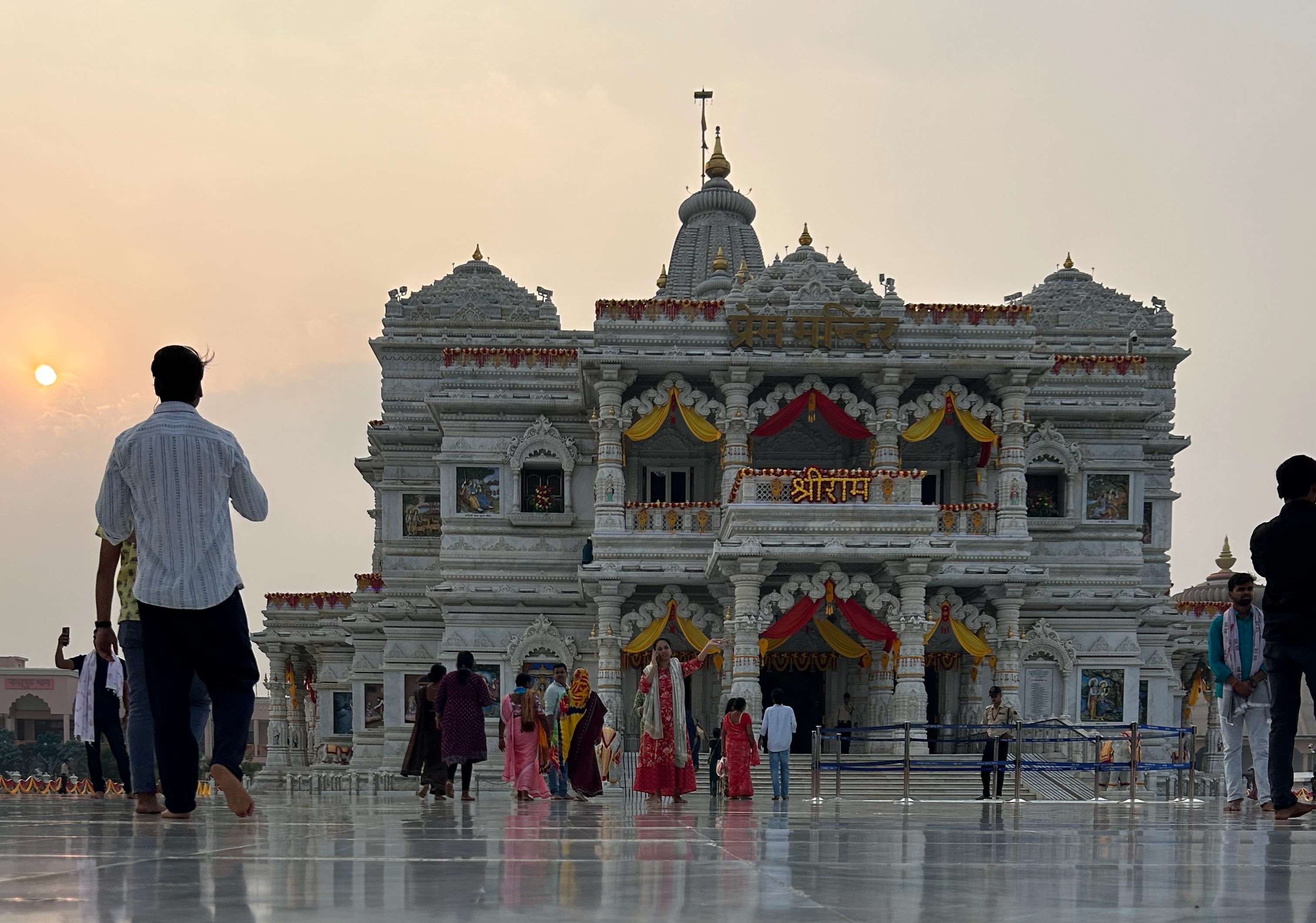
By afternoon, I was back in Vrindavan. The crowd at Prem Mandir looked overwhelming, but curiosity won. The line for women moved swiftly, and within minutes I stood inside a vast marble complex where devotion and architecture met in perfect harmony. Tableaux from Krishna’s life lined the approach to the temple — scenes from Govardhan, Rasleela, and Kaliya Mardan — each carved in intricate detail. The crowd no longer felt like a crowd; it felt like community.
The Curtain Falls at Banke Bihari Temple
My final stop was the Banke Bihari Temple, where the playful aspect of Krishna is worshipped. The idol, believed to have appeared in Nidhivan, is known to be so charming that the priests periodically draw a curtain — lest devotees lose themselves in his gaze.
Navigating the lanes took effort, and I nearly lost my way back, mistaking one identical shop for another while trying to retrieve my juttis. The small confusion felt fitting for Vrindavan — a town where divine playfulness extends even into mundane moments.
Evening Reflections: A City That Chooses You
As I walked back, the sound of kirtans filled the streets. Monks from ISKCON sang “Hare Krishna” in unison, their cymbals echoing through the festive air. Shops and homes glittered in Diwali lights, and everyone greeted one another with a gentle “Radhe Radhe.”
Some places you plan to visit; others seem to summon you. Vrindavan, I realised, had chosen me for this long weekend — to remind me that faith isn’t always about ritual. Sometimes, it’s about rhythm, stillness, and surrender in a place where every corner hums with devotion.
Durga Puja is not just a festival—it is an emotion. It is five days of togetherness, rituals, food, and celebration that culminate in a bittersweet farewell on Dashami. This year, as always, the last day carried the weight of both joy and sorrow.
The Morning Frenzy
The day began early. Perhaps it was the thought that Maa would soon leave us that stirred everyone out of bed early. The morning saw the house buzzed with unusual urgency.
As part of the ritual, a yellow cloth is cut to make áparajita bands to be tied at the end of the day. But the cloth was nowhere to be found. We searched every corner, a mild panic building, since on Dashami most shops remain shut. Just when we thought we’d have to improvise, one cousin dashed to the market nearby—and to everyone’s relief, found one open shop. The yellow cloth was procured, and with it, calm returned.
Preparing to Welcome and Bid Farewell
Tradition has it that on Dashami, Maa is treated like a daughter leaving her paternal home. The customs reflect this deep symbolism.
A boron thala was readied—filled with sindoor, dahi, dhan, durba, paan, and sweets. What made the moment especially endearing was watching a mother-in-law and daughter-in-law prepare it together, bridging generations through ritual.
Meanwhile, my sister-in-law reminded us that the kolabou from the puja mandap would be brought inside. A spot had to be decorated with rangoli. Not being the best rangoli artist, I began hesitantly until one of my nieces joined me. Together, we managed something that, if not perfect, passed muster with cheer.
The Last Arati and Bhog
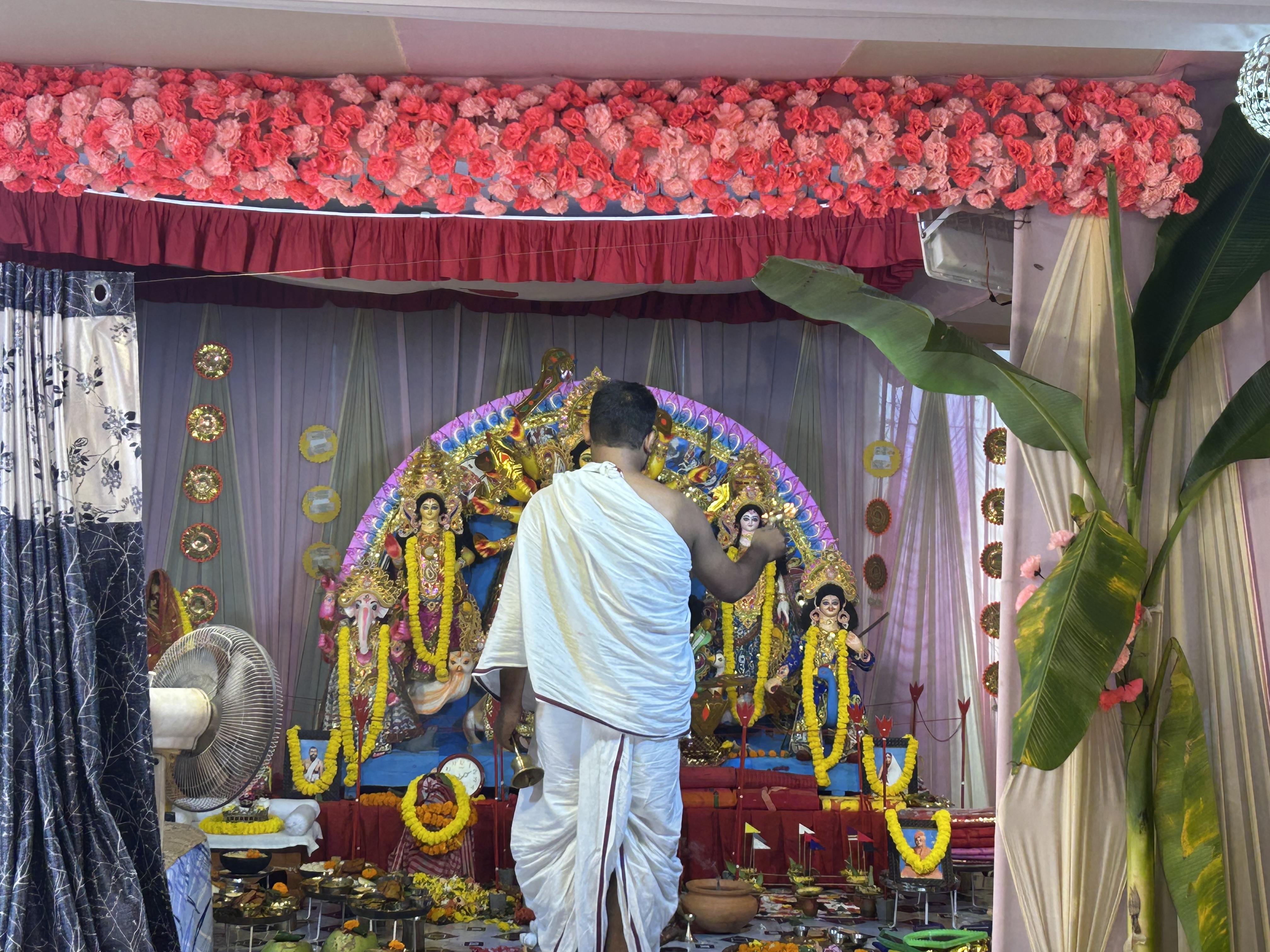
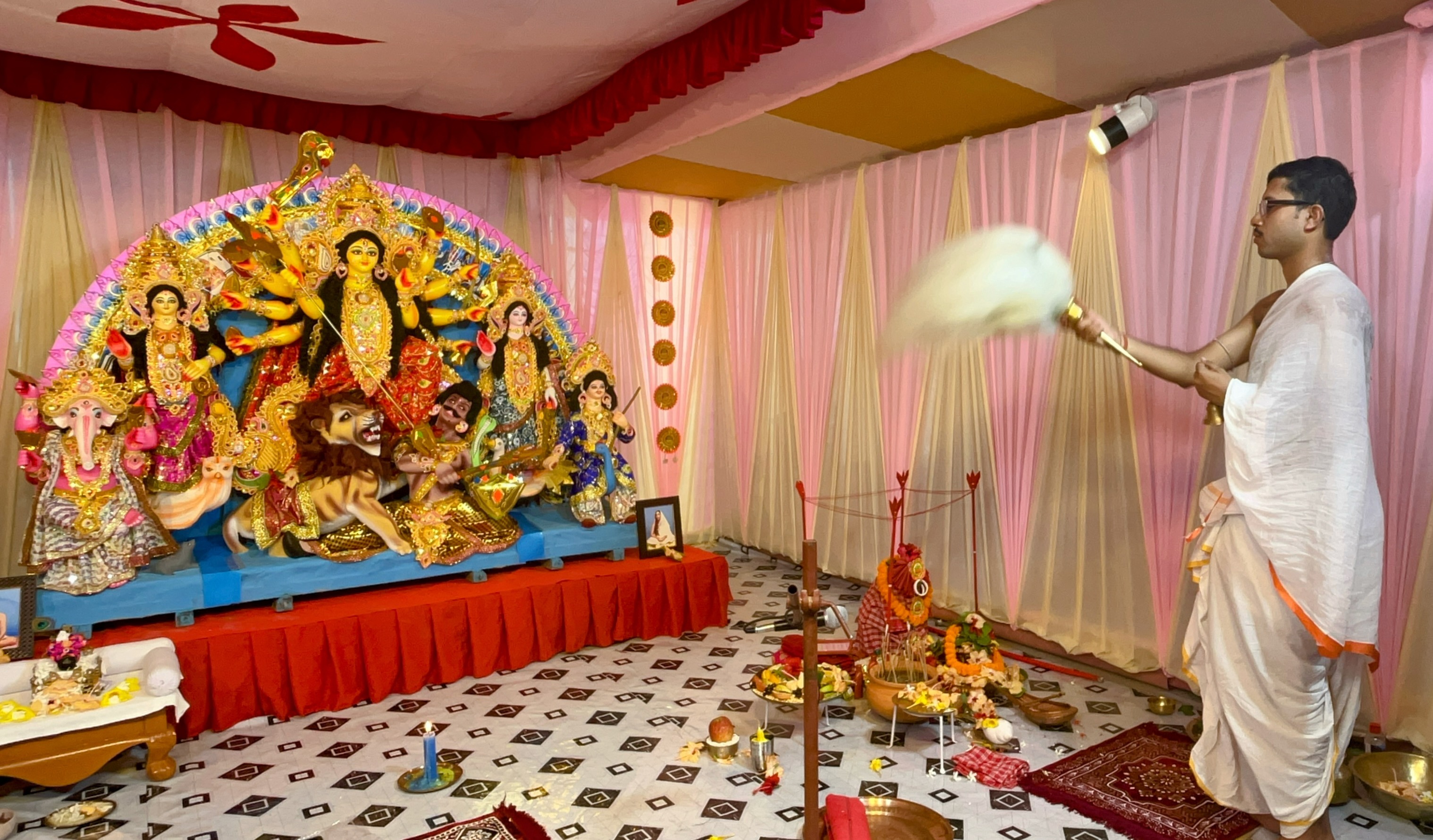
At the mandap, the final arati took place, filling the air with conch shells, incense, and the mingled emotions of farewell. The bhog of the day was humble yet deeply comforting—siddho bhaat, rice with boiled vegetables, served with ghee and chura, dahi, and gur.
This meal carried a personal memory too. Growing up, whenever we returned from holidays from my maternal uncle’s house, my mother would like to eat siddho bhaat, believing it was the best way to reset the body. Eating it again on Dashami felt like a return to roots.
Before the farewell, a large mirror was placed in a bowl of water, positioned so that Maa’s face was reflected. We were asked to bid adieu as we looked into the reflection. The symbolism was powerful, and the moment left everyone quiet, reluctant to let go.
Sindoor Khela and Procession to the River
Soon after, the mood shifted to festivity. Married women gathered for sindoor khela, smearing vermillion on each other in a celebration of womanhood, prosperity, and joy. Laughter rang out, faces turned red with sindoor, and the air carried a lighter note.
The kolabou was ceremonially brought inside, and preparations began for visarjan. The idols were carefully loaded onto a mini truck, followed by a convoy of vehicles. Children, especially, were excited at the thought of walking to the Barak River, three kilometers away.
But the skies had other plans. As we left, a drizzle began, soon turning into heavy rain. A tarpaulin was pulled over the idols, and we scrambled for cover. Eventually, many of us found shelter in the vehicles, though the rain and the rush meant the journey became chaotic. Yet, in its own way, this chaos carried its charm.
At Sadar Ghat: The Immersion
After nearly an hour and a half, we reached Sadar Ghat, the town’s main immersion site. Trucks rolled in one after another, and idols were transferred onto wheeled platforms before being taken to boats.
The sight was surreal—the rhythmic movement of idols, the chants of “Bolo Durga Mai ki… Jai!”, the synchronised immersion as each idol was pushed gently into the river. Everything happened with clockwork precision, and just like that, Maa was gone.
There was not a dry eye as we turned back.
Holding on to What Remains
Durga Puja is fleeting, but its aftertaste lingers. In a day or two, everyone will return to routine life, schools and offices, deadlines and duties. Yet these five days of togetherness, the shared meals, laughter, rituals, and even the frantic searches for a missing cloth, are memories that remain etched forever.
As we bid adieu to Maa, we carry with us the assurance that she will return again next year, and until then, her blessings stay with us.
Navami dawned with a quiet urgency. It was the last full day Maa would be home with us, and I wanted to soak in every moment. So, dressed in my puja finery, I made my way to the mandap, where the goddess seemed to hold court amidst fragrance, light, and laughter.
Durga Puja, for Bengalis, is more than a festival. It is the homecoming of a daughter. Every offering, every ritual, every sound and flavor carries the symbolism of how a daughter is pampered when she returns to her parental home. Navami, coming after the solemnity of Ashtami and the intensity of Sandhi Puja — when the goddess is believed to have slain Mahishasur — is lighter in mood, filled with a sense of celebration but also tinged with an approaching farewell.
Discoveries at the Mandap
As I entered, something unusual caught my eye — a neatly made bed placed at the mandap. Curious, I asked my sister-in-law, who explained it was an offering to the goddess. Like a daughter who has come home after a long time, she must be cared for, made comfortable, and indulged. Standing there, I realized how much one can learn by simply watching the rituals closely: the goddess is not distant; she is family.
The air vibrated with familiar sounds — the dhak, the clash of kasor, the rhythmic ululations, and the deep resonance of the shankh. Each day I had tried, and failed, to blow the conch shell. But on this morning, almost to my surprise, the sound emerged clearly. It was fleeting, for when I tried again, it eluded me. My aunt, of course, then stepped in to demonstrate her flawless skill, as if reminding us that these rituals are not just sacred — they are also playful, communal, full of laughter and learning.
The Sacred Fire
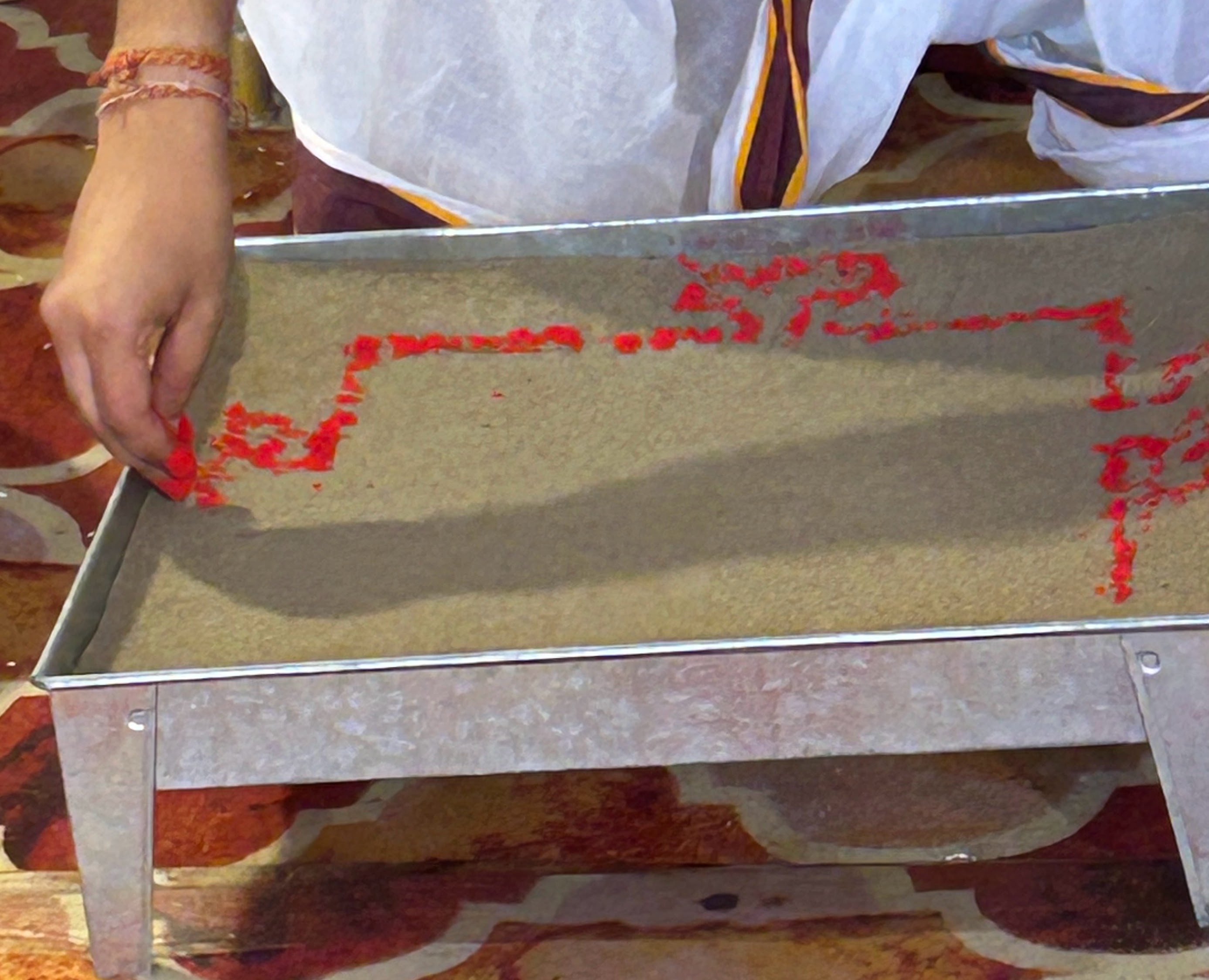
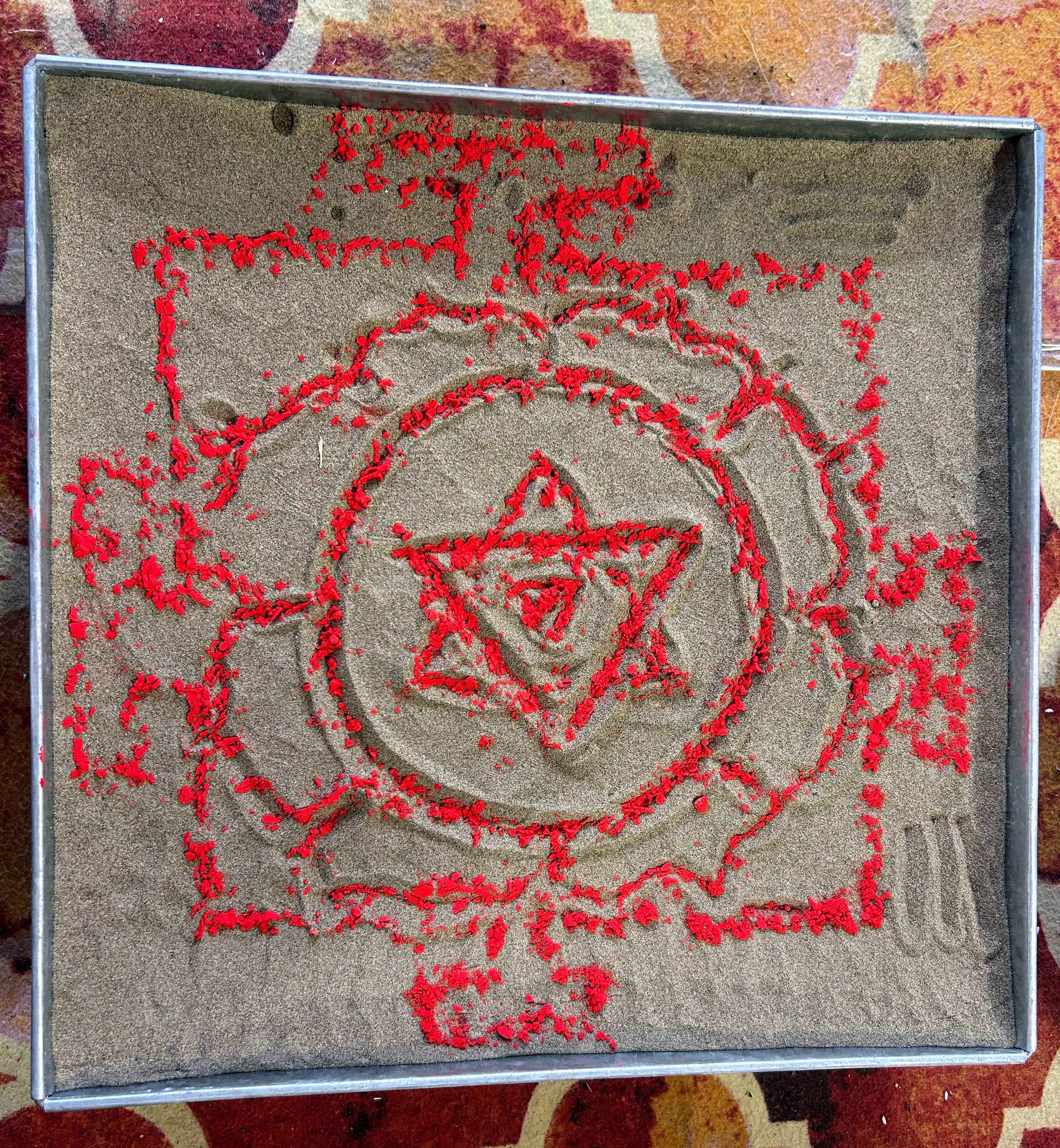
After the arati and pushpanjali, preparations began for the havan. A metal kund was filled with sand, rangoli patterns were drawn, and small wooden twigs were stacked carefully before being lit with the chanting of shlokas. Watching my family gather — the elders with folded hands, the younger ones capturing the moment on their phones, and children gazing on with wide-eyed curiosity — I felt how rituals create a tapestry of generations. Each of us participates differently, yet all are bound by the same flame, the same prayer.
The havan stretched into the afternoon, its rhythm slow and meditative, until the sacred fire gave way to another ritual no less holy for Bengalis — the bhog. Plates of steaming prasad were served, and we descended with eagerness. With a puja at home, every meal was vegetarian, but the variety revealed the richness of Bengali vegetarian cuisine — a tradition often overshadowed by our famed fish and meat dishes. Each bite was a reminder that food, too, is devotion.
The Evening Glow
As twilight approached, the mood softened. Navami evenings are bittersweet. They are filled with joy, for Maa is still with us, but also with an unspoken sadness that the festival is nearing its end. The dhunuchi dance, the laughter, the casual adda — everything seemed brighter, livelier, because we knew it would soon be over.
Durga Puja is not just about rituals. It is about the coming together of family, the blending of the sacred and the everyday, the music and the meals, the stories and the silences. It is about homecoming — not just of the goddess, but of all of us, returning to roots, to belonging, to shared memories.
Carrying the Light Forward
When Maa comes home, everything brightens. And yet, as her departure nears, I realize that the beauty of Durga Puja lies not only in her presence but also in the light she leaves behind. The mandap, the dhak, the laughter of family, the taste of bhog — all of it becomes memory and meaning, carried within us until the next autumn when the daughter returns again.
Durga Puja, in its essence, teaches us that joy and impermanence walk hand in hand. That even departures are sacred, for they remind us to cherish the moments we have.
And so, on Navami, as Maa prepared to leave, I understood: she never truly goes away.
Last night, word spread through the house: Mangal Arati at 4 a.m. sharp. This was the sacred hour to wake Maa on Ashtami morning. At that hour, someone gently nudged me awake. True to my nature, I turned, muttered something unintelligible, and went back to sleep. I do love my sleep, perhaps too much.
As a child, Ashtami meant a kind of magic. I remember watching clothes, fruits, and sweets being laid out before Maa, offerings that seemed larger than life to my young eyes. Pushpanjali was always the heart of the day—Bengalis in their finest new clothes, palms folded, flowers in hand, chanting in unison. It was a ritual that seemed to stitch devotion and identity together.
This morning, I found myself again in the role of the family’s saree-draper. It’s become an unspoken responsibility: draping pleats for cousins and younger members before the puja begins. Oddly enough, it fills me with joy. There’s a kind of generational continuity in the act—like passing down a secret language without words.
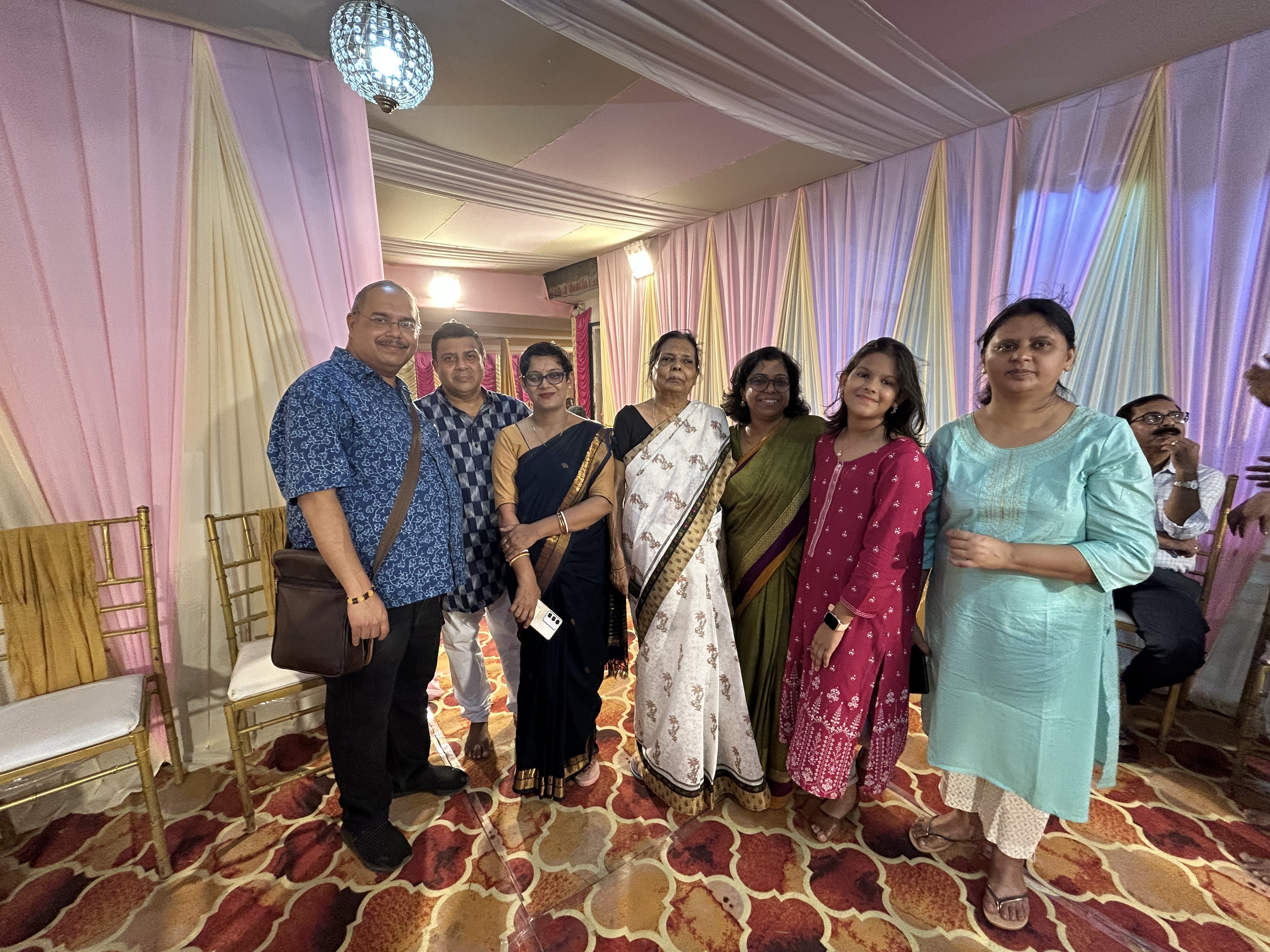
After the prayers came the easy camaraderie: photos snapped in half-serious poses, bursts of adda, the gentle chaos of laughter filling corners of the home. Lunch was a feast, as always, with a steady stream of guests braving not just the festive crowd but also the sweltering heat of the afternoon.
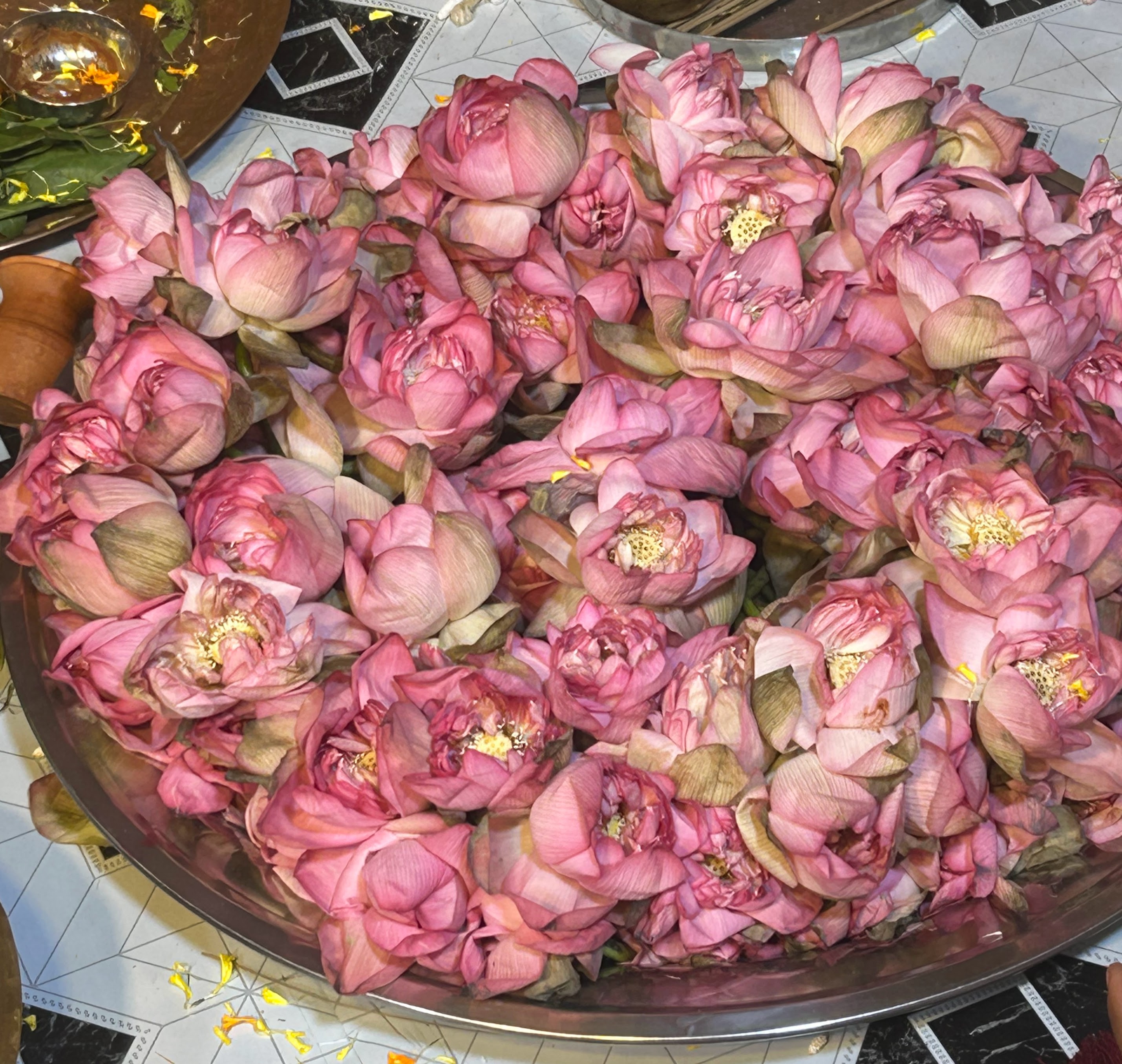
But it is the Sandhi Puja that transforms the day. That threshold moment when Ashtami gives way to Navami, when the sacred is marked with 108 lotuses and 108 diyas. This year, nature seemed to conspire with the ritual. Just as we prepared, a thunderstorm rolled in—lightning tearing across the sky, thunder echoing like a drum, and rain draping the world in cool relief.
Then, in fresh clothes (yes, yet another round of changing), the family gathered again. One by one, the diyas were lit. There is something indescribably moving about watching flames multiply in the dark, each light a small prayer, a small connection, and doing it together as a family turns it into something eternal.
And just like that, two days of Puja slipped past in a blink. The festivities, the laughter, the rituals—they always feel too brief. Yet they leave behind something lasting. The memory of a saree draped, a diya lit, a storm cooling the air, and the simple joy of being together.
These moments remind me that festivals are not just about tradition or ritual—they are about memory-making, about weaving together the ordinary and the sacred into stories we carry with us long after the drums fall silent.
The day began at sunrise. My brother woke us up, reminding us that Chandi Puja was scheduled to start at 6 a.m. The quiet of the morning soon gave way to the rhythmic chants of shlokas, and with that the day unfolded into one steeped in devotion, tradition, and togetherness.
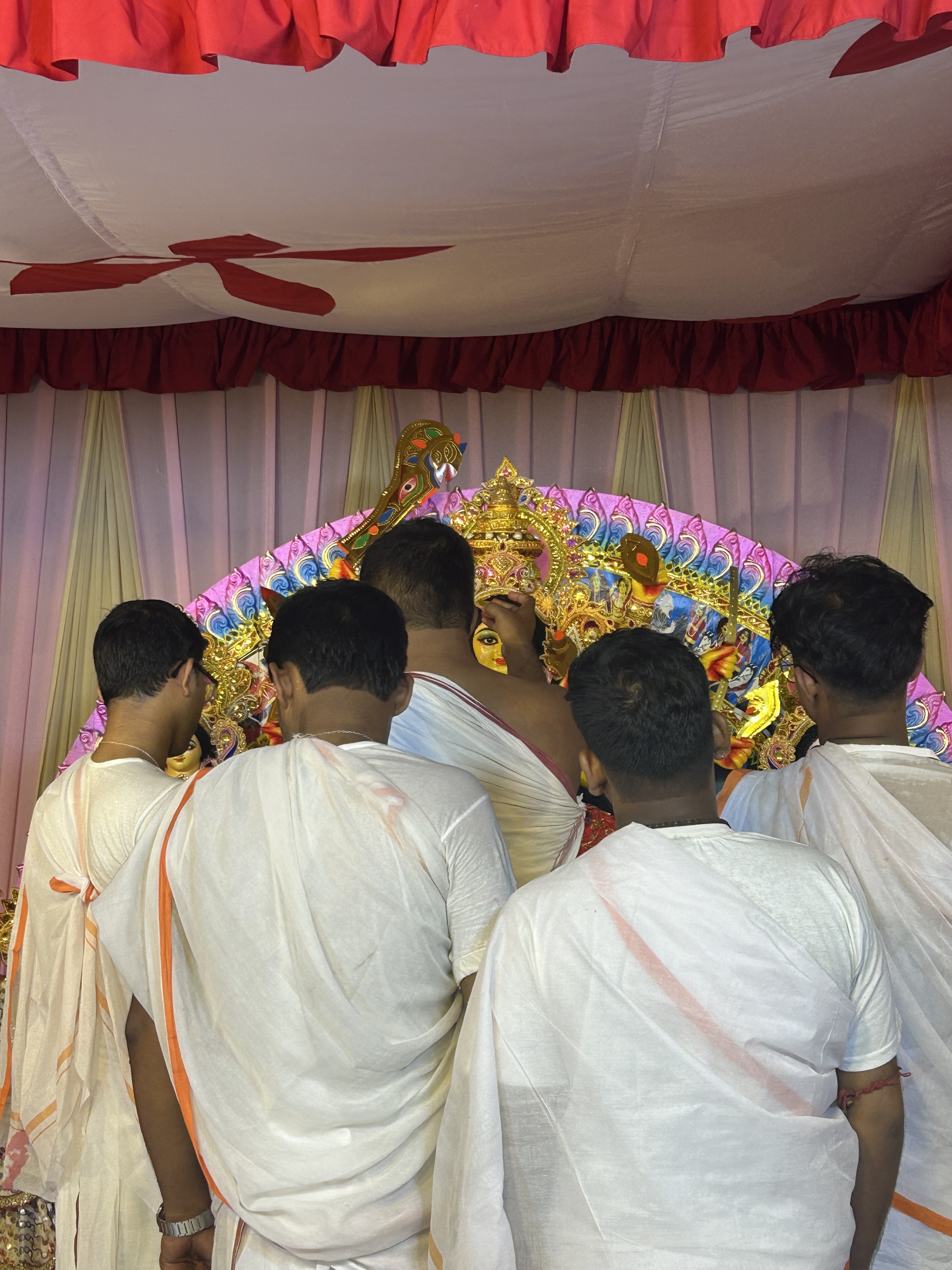
The Young Purohits: Tradition in New Hands This year’s puja carried a unique touch — the rituals were conducted by a group of young purohits in their twenties. It was both heartening and reassuring to watch tradition being carried forward so earnestly. What struck me most was a young Purohit, a student doing his masters, reciting the Chandi Path with impeccable diction and clarity.
As I listened, memories came rushing back, of my childhood, when my eldest uncle would perform the Chandi Path. That sound had long been my only reference for this sacred recitation. Watching the next generation step into that role was a reminder of how rituals survive through continuity, transforming into lived heritage.
The Sacred Offering: Bhog-er Prasad Around noon, it was time for the bhog-er prasad. This is not a meal in the conventional sense but a divine mash-up of everything offered to Maa — from lemon to Anna bhog to payesh. The mix, though unusual, always tastes heavenly, not only for its flavors but because it is sanctified as Maa’s blessing.
Evening Rituals: Sashti, Kola Bou and Pran Pratistha The evening brought with it the rituals of Sashti and the preparation of Kola Bou, symbolizing the nine sacred plants or Nabapatrika. Kola Bou reinforces our eternal connection with nature, reminding us that the festival is as much about celebrating divinity as it is about honoring the earth that sustains us. This was followed by the elaborate ritual of Pran Pratishtha, when life is invoked in the idol.
Beyond the Mandap: The Joy of Togetherness But puja is never just about rituals. It is about everything that happens around the rituals — the pranks, the eagerness to dress up, slipping back into the cool AC room after braving the heat of the mandap, and the endless adda sessions that spill over from morning to night. These moments are what bind families and generations, adding warmth to the devotion.
A Day to Remember Chandi Puja is said to be an integral part of Durga Puja, yet for me it has always carried the memory of one elder’s voice, one family moment. Experiencing it in this way — led by the young, shared in the company of many, and accompanied by laughter and joy — made the day unforgettable.
Durga Puja is not just worship; it is living culture. It is where tradition meets memory, devotion meets joy, and Maa comes home in a thousand little ways.
Durga Puja is special for every Bengali. But this year, it turned extra special. This year, Maa came home.
What does it feel like when Maa comes home? It feels like months of planning and tons of shopping. It feels like chaos that somehow turns into joy. It feels like generations coming together—airport meetups filled with hugs, endless food, dressing up in silks and kurtas, and continuous adda sessions that carry through the night.
For me, Durga Puja has always been a community festival. My most vivid memory was from Kolkata, when our apartment complex organised the Puja—collective, chaotic, and deeply rooted in togetherness. I had only read about ghar-er pujo—Durga Pujas held at home—or seen them recreated in films. So when my cousin decided to organise one this year, I knew I had to be there.
And let me tell you, to call it “challenging” is an understatement. Durga Puja is often described as a Rajashik puja—one that kings performed. And here, a family carrying on this grand tradition at home.
I woke up before dawn, ran across airports to catch connecting flights, and landed in the sweltering heat and humidity of Silchar. It was Panchami—the fifth day of Navratri—and time for the first ritual, Bodhon, where Maa Durga is ceremonially invited.
The evening was filled with frantic activity when a power cut threatened to plunge everything into darkness. Out came our mobile phones, lighting up the puja mandap in a glow both modern and makeshift. But Maa, it seemed, wasn’t amused by this arrangement. The power cut lingered, and finally, generators whirred to life, bathing the mandap in light once more. Just when we thought we would melt away in the humid heat, the electricity returned—as if Maa had decided it was time to ease our troubles.
And then it began. The sounds of the conch, ulu, and dhak filled the air, announcing what our hearts already knew— Maa had come home.
Hauz Khas has always been that buzzing South Delhi address — synonymous with nightlife, chic cafés, designer boutiques, and a medley of world cuisines. For me, it had long existed as that happening urban village, where the city comes to unwind. Someone had once mentioned there were “some old monuments” tucked away there, but then, Delhi has monuments scattered like punctuation marks in its long, layered history.
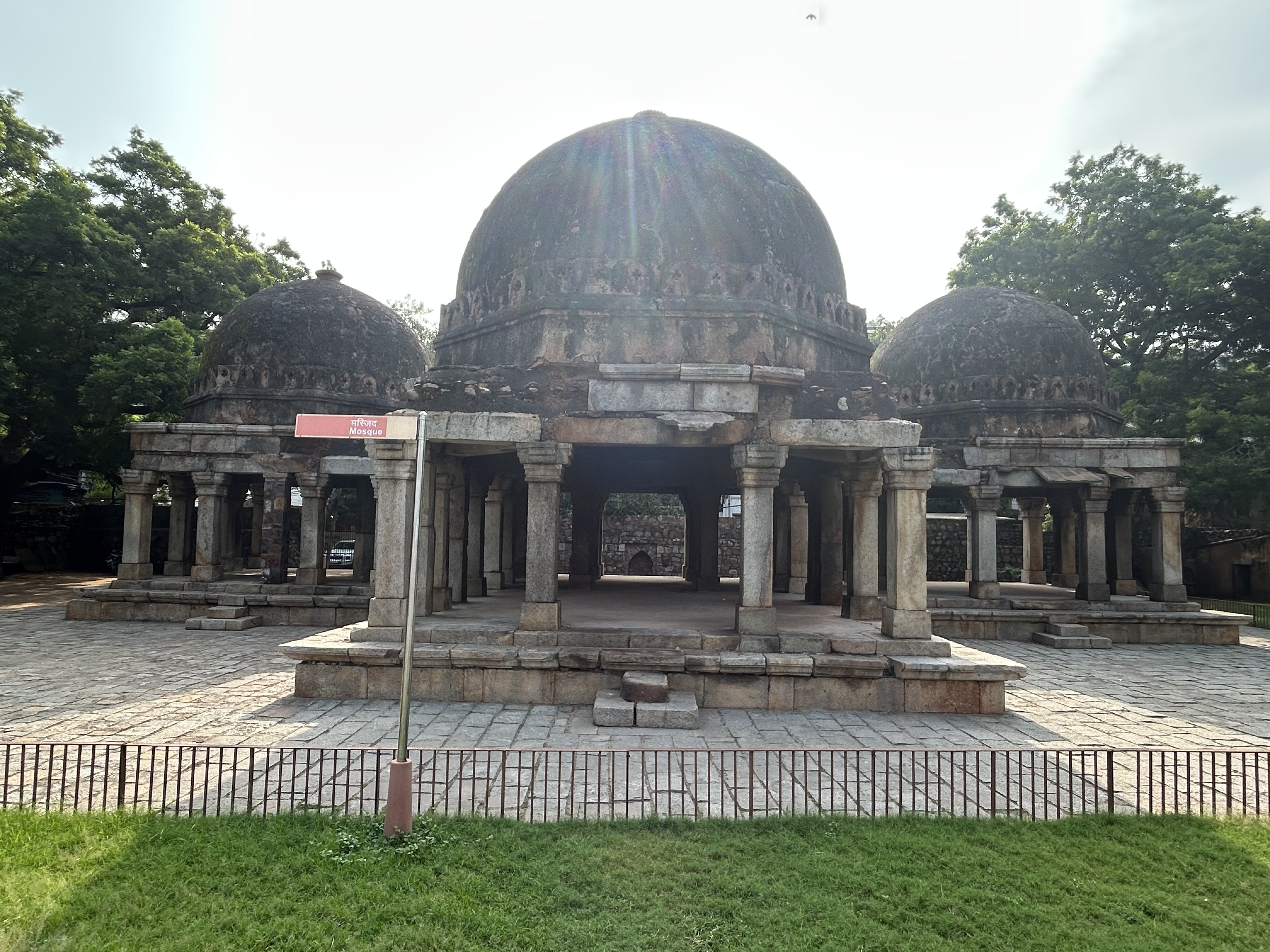
So when an email from INTACH dropped into my inbox about a heritage walk through Hauz Khas, curiosity nudged me to sign up. That is how, on a quiet Sunday morning, I found myself standing with fellow history enthusiasts at the gates of the Hauz Khas mosque — ready to peel back the centuries, guided by the brilliant storyteller Ratnendu Roy.
Stepping Into a Medieval Campus
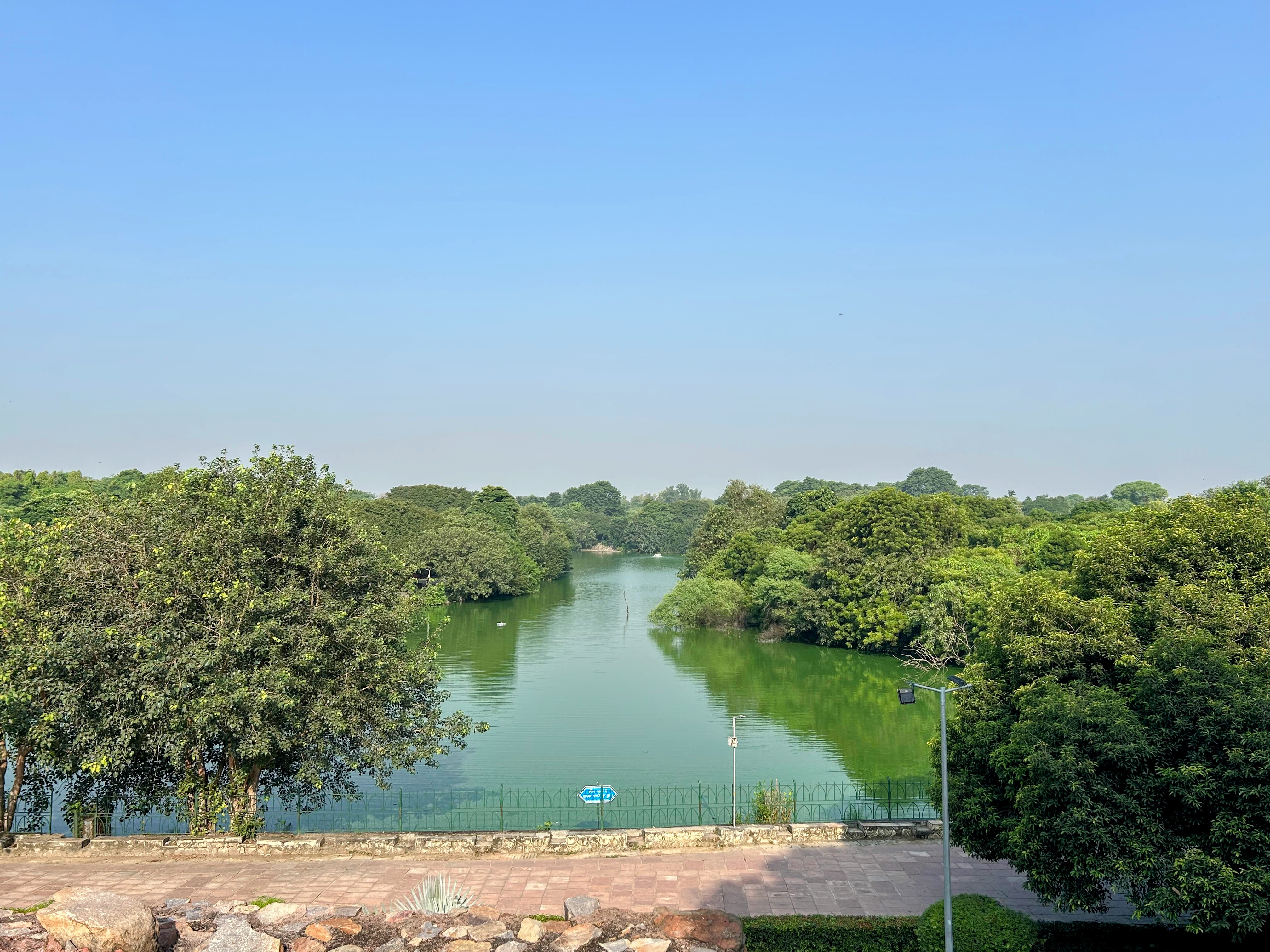
Hauz Khas was originally built by Alauddin Khilji and reached its pinnacle under Firoz Shah Tughlaq. As we walked into the mosque and madrasa complex — complete with hostel cells once meant for students — it was easy to imagine its glory days: serene gardens, the expansive water tank shimmering beyond, and scholars breathing life into its stone corridors.
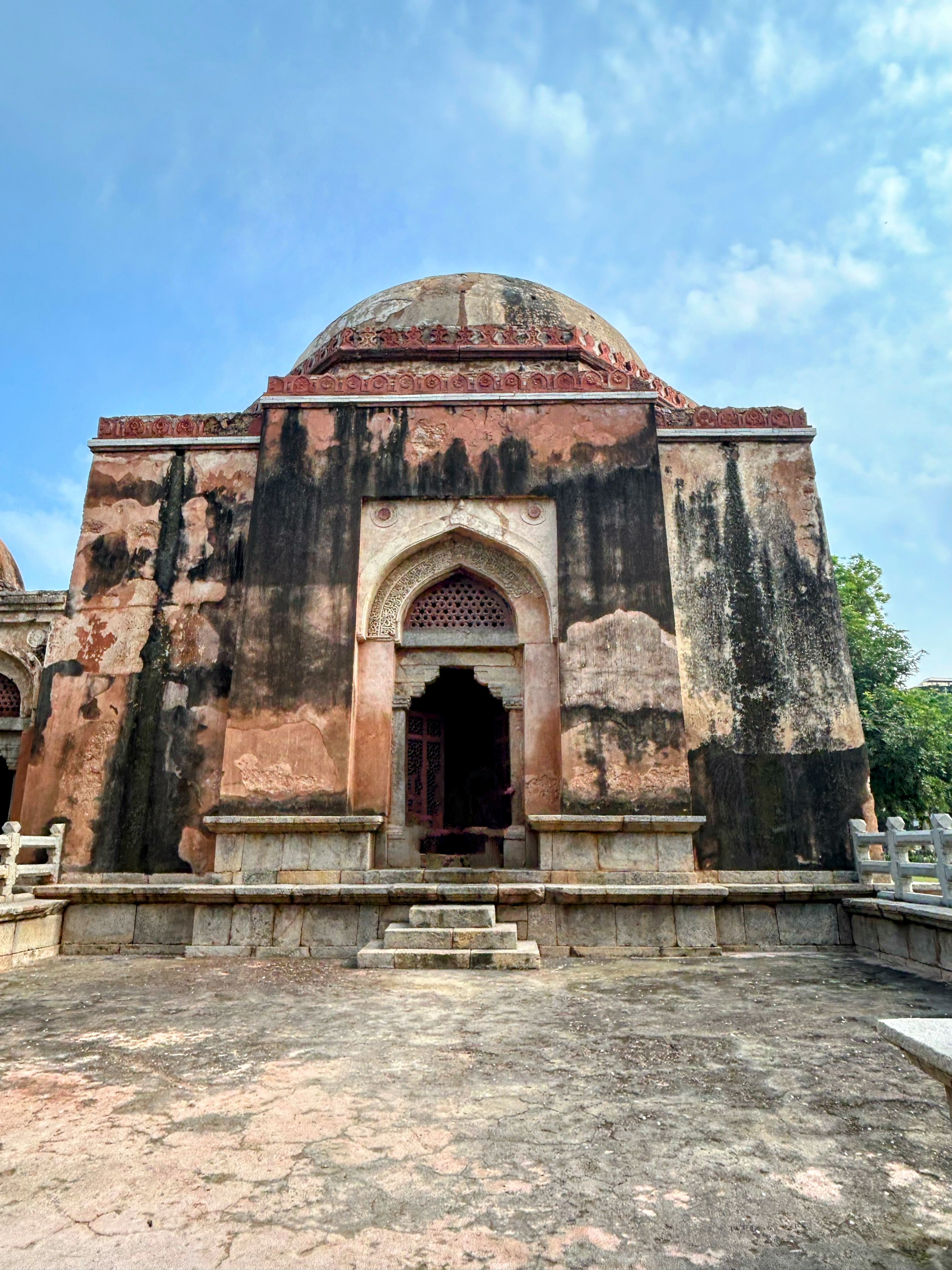
Tucked within the complex are several tombs, the most prominent being that of Firoz Shah himself. Legend has it that the surrounding village grew as an ecosystem around this premier centre of learning. Even today, gazing out from the madrasa’s colonnaded windows towards the hauz (reservoir), the scene feels remarkably tranquil — as if time has paused just for a moment.
From Forgotten Village to Trendy Hotspot
Hauz Khas village lay largely forgotten until the mid-1980s, when designers and café owners “discovered” its rustic charm. Boutiques sprang up in old village homes, and the area morphed into Delhi’s go-to party destination. Yet behind the neon signs and polished façades, you can still spot the original mud-brick houses — a whisper of the village it once was.
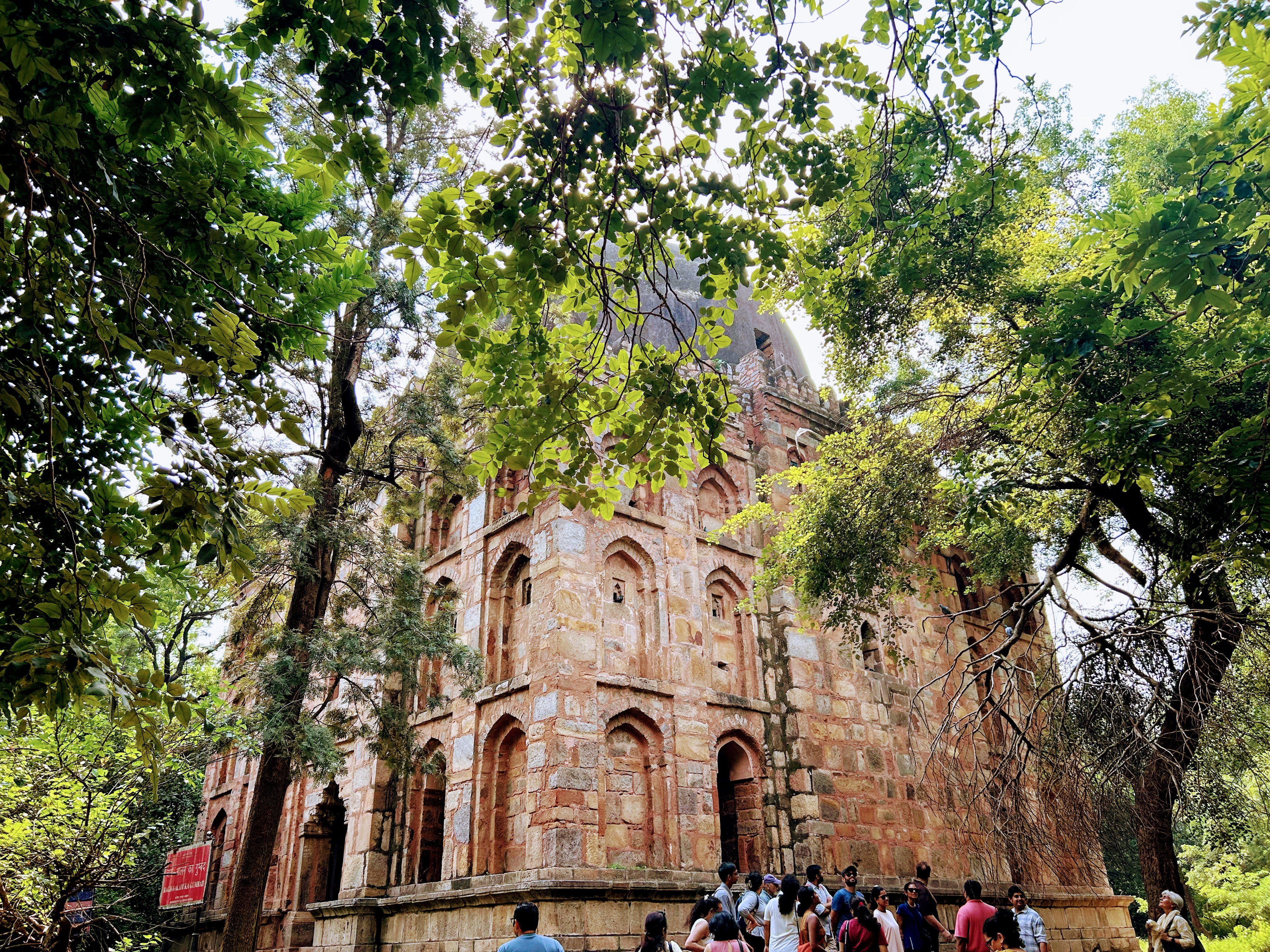
A short stroll led us into the lush Deer Park. It is one of those rare green islands in Delhi where city sounds dim into silence. Joggers, families, and groups of friends dotted the winding paths. Within its leafy expanse stand two medieval gems: the Lodhi-era Bagh-e-Alam ka Gumbad, said to have taken inspiration from Firoz Shah’s tomb, and the diminutive Kali Gumti, whose cenotaph has vanished into history’s mists.
Munda Gumbad and the Whisper of the Wind
The walk ended at Munda Gumbad — literally the “headless dome” — a pleasure pavilion once located on an island in the middle of the reservoir. Encroachments have since pushed the water’s edge far back, but the charm lingers. Climbing the short steps, I was met with a 360° panorama: the green canopy of the park, the stone silhouettes of monuments, and the glimmering water. A soft breeze wrapped around us, and I found myself imagining an earlier time — boats gliding across the water, ducks splashing, and royalty reclining under the dome to escape the summer sun.
As we were walking towards the Munda Gumbad, a sudden rustling and cacophony above made us look up — a massive colony of bats hung like dark fruits from the branches overhead. I had never seen so many at once; they seemed like watchful guardians of the place’s secrets.
Threads Between Past and Future
Along the walk, our conversations meandered — from vandalised monuments and encroached heritage zones to the challenges of restoration, the scarcity of funds, and the lack of public awareness. It struck me then: history is not just an episode of the past. It is a thread that connects us to the future — a legacy to be understood, protected, and cherished.
A Sunday morning, well spent. A city rediscovered.
























 Jajabor