This morning, I woke up to the crackle of crackers and devotional songs in praise of Chhathi Maiya from the temple next door. Coffee in hand, I watched from my balcony as families offered prayers to the Sun — a familiar scene that somehow always feels new. Later at work, a colleague pressed a small packet of thekuas and fruits into my hand. And as I took that first crunchy bite, I realized something: every year, without consciously seeking it out, I wait for the prasad of thekua. Chhath has always lived at the edges of my life — never my festival, yet always present in my world.
My earliest memory of Chhath is from childhood in Khonsa, Arunachal Pradesh. The town had just one river — a mountain stream that roared during monsoons but, for the rest of the year, became the gathering place for all rituals, from Durga visarjan to Chhath puja. An attendant in my father’s office, originally from Bihar, would bring prasad from the celebrations. His wife — a fierce, unlettered woman with big dreams for her four children — always saved a few extra thekuas for me. She called me “mamoni,” and that love tasted like jaggery and cardamom.
Silchar was different. Predominantly Bengali, yet home to enough Bihari families to light up the banks of the Barak River for Chhath. Some years, thekuas would find their way to our home; other years, the festival passed quietly. But the expectation never dimmed.
Then came work life — new cities, new colleagues, and the same familiar warmth. Wherever I’ve gone, someone celebrating Chhath has always remembered how much I love thekuas. And so, the tradition continues: a festival not mine by birthright, but one claimed through affection, generosity, and food.
It fascinates me how food connects us to cultures beyond our own. Onam isn’t a Bengali festival either, but the joy of a sadya has made it mine. My years in Mumbai sealed my lifelong devotion to modaks during Ganesh Puja. Perhaps that’s the beauty of living in many places — we inherit new traditions not through rituals, but through taste.
Some festivals we are born into. Others adopt us quietly — one delicious thekua at a time.
Durga Puja is not just a festival—it is an emotion. It is five days of togetherness, rituals, food, and celebration that culminate in a bittersweet farewell on Dashami. This year, as always, the last day carried the weight of both joy and sorrow.
The Morning Frenzy
The day began early. Perhaps it was the thought that Maa would soon leave us that stirred everyone out of bed early. The morning saw the house buzzed with unusual urgency.
As part of the ritual, a yellow cloth is cut to make áparajita bands to be tied at the end of the day. But the cloth was nowhere to be found. We searched every corner, a mild panic building, since on Dashami most shops remain shut. Just when we thought we’d have to improvise, one cousin dashed to the market nearby—and to everyone’s relief, found one open shop. The yellow cloth was procured, and with it, calm returned.
Preparing to Welcome and Bid Farewell
Tradition has it that on Dashami, Maa is treated like a daughter leaving her paternal home. The customs reflect this deep symbolism.
A boron thala was readied—filled with sindoor, dahi, dhan, durba, paan, and sweets. What made the moment especially endearing was watching a mother-in-law and daughter-in-law prepare it together, bridging generations through ritual.
Meanwhile, my sister-in-law reminded us that the kolabou from the puja mandap would be brought inside. A spot had to be decorated with rangoli. Not being the best rangoli artist, I began hesitantly until one of my nieces joined me. Together, we managed something that, if not perfect, passed muster with cheer.
The Last Arati and Bhog
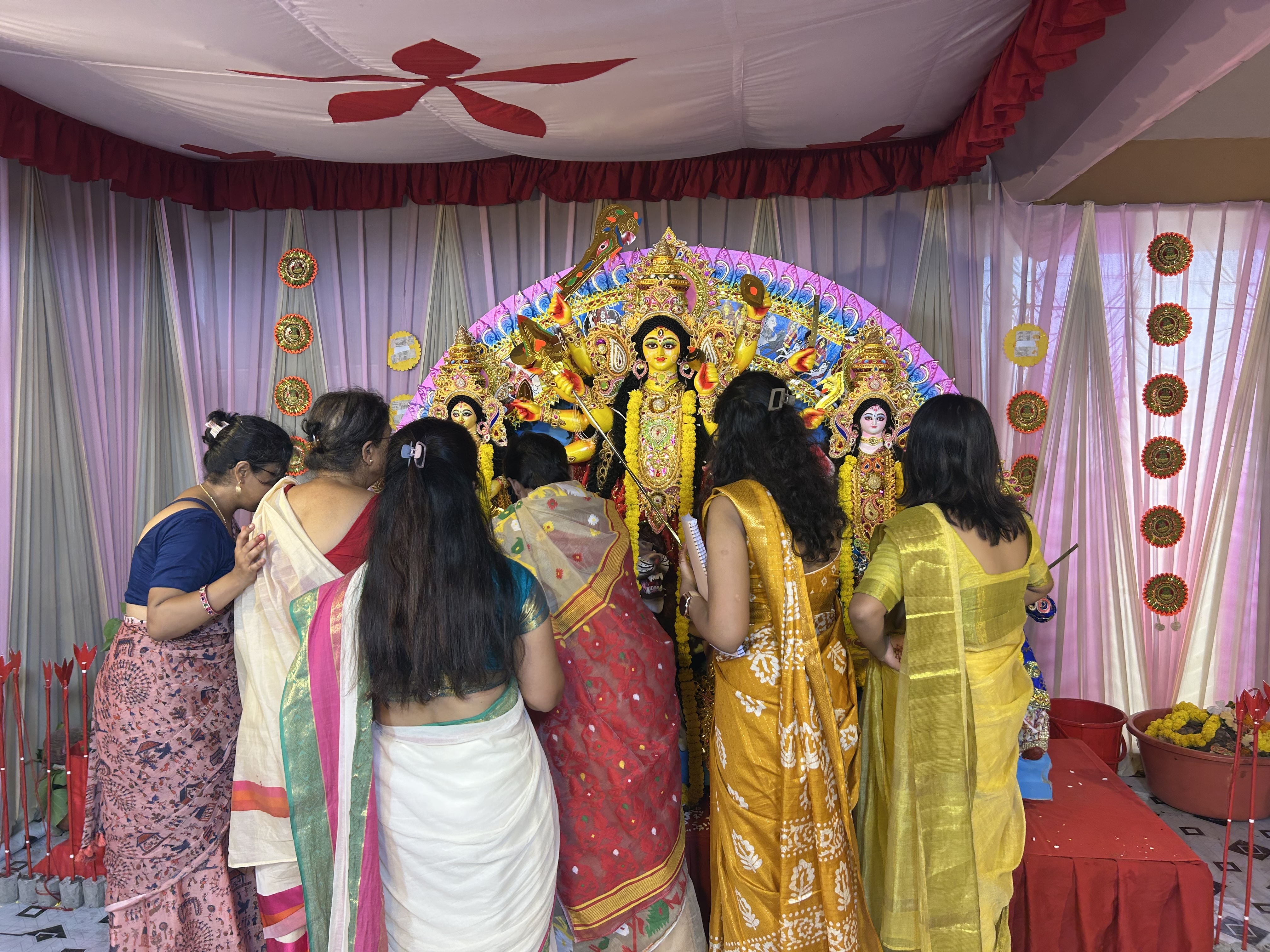
At the mandap, the final arati took place, filling the air with conch shells, incense, and the mingled emotions of farewell. The bhog of the day was humble yet deeply comforting—siddho bhaat, rice with boiled vegetables, served with ghee and chura, dahi, and gur.
This meal carried a personal memory too. Growing up, whenever we returned from holidays from my maternal uncle’s house, my mother would like to eat siddho bhaat, believing it was the best way to reset the body. Eating it again on Dashami felt like a return to roots.
Before the farewell, a large mirror was placed in a bowl of water, positioned so that Maa’s face was reflected. We were asked to bid adieu as we looked into the reflection. The symbolism was powerful, and the moment left everyone quiet, reluctant to let go.
Sindoor Khela and Procession to the River
Soon after, the mood shifted to festivity. Married women gathered for sindoor khela, smearing vermillion on each other in a celebration of womanhood, prosperity, and joy. Laughter rang out, faces turned red with sindoor, and the air carried a lighter note.
The kolabou was ceremonially brought inside, and preparations began for visarjan. The idols were carefully loaded onto a mini truck, followed by a convoy of vehicles. Children, especially, were excited at the thought of walking to the Barak River, three kilometers away.
But the skies had other plans. As we left, a drizzle began, soon turning into heavy rain. A tarpaulin was pulled over the idols, and we scrambled for cover. Eventually, many of us found shelter in the vehicles, though the rain and the rush meant the journey became chaotic. Yet, in its own way, this chaos carried its charm.
At Sadar Ghat: The Immersion
After nearly an hour and a half, we reached Sadar Ghat, the town’s main immersion site. Trucks rolled in one after another, and idols were transferred onto wheeled platforms before being taken to boats.
The sight was surreal—the rhythmic movement of idols, the chants of “Bolo Durga Mai ki… Jai!”, the synchronised immersion as each idol was pushed gently into the river. Everything happened with clockwork precision, and just like that, Maa was gone.
There was not a dry eye as we turned back.
Holding on to What Remains
Durga Puja is fleeting, but its aftertaste lingers. In a day or two, everyone will return to routine life, schools and offices, deadlines and duties. Yet these five days of togetherness, the shared meals, laughter, rituals, and even the frantic searches for a missing cloth, are memories that remain etched forever.
As we bid adieu to Maa, we carry with us the assurance that she will return again next year, and until then, her blessings stay with us.




 Jajabor