All posts by Jajabor

Unknown's avatar

About Jajabor

My best memories have always been my journeys. Observing people, places, nuances, customs, food habits, clothes, and little idiosyncrasies—that’s my favorite pastime. Somewhere along the way, without even realizing it, I fell in love with traveling. And no, I’m not talking about the packaged kind with fixed itineraries and hurried photo stops. I’m talking about unraveling a place—layer by layer. Because the best memories of a trip are rarely from what’s printed in the brochure; they’re born from the moments beyond it. For safety, I might let a tour operator book my hotels, but the rest? That’s mine to discover. I read about the place, strike up conversations with locals, and follow history’s faint whispers down winding lanes. There’s a certain thrill in peeling back a place’s layers—its stories, its silences, its soul. I hope, through my words, I can share that thrill with you.

An Evening of Craft, Cuisine, and Community at The Kunj

Growing up, there was a saying often used to describe a familiar irony: “When you stay next door to the station, you will miss the train.” It referred to situations in which, despite proximity, one keeps postponing a visit. That line came back to me on Saturday, when I finally managed to visit The Kunj—India’s first mall dedicated entirely to handloom and handicrafts.
Located within walking distance from my home, The Kunj has been on my mind since its opening in August 2025. And yet, like the proverbial train, I kept missing it.
As I stepped out of the lift, the first sight that greeted me was a loom and a vibrant seating area—an immediate signal that this was not just another retail space. Handicraft and handloom stores showcasing products from across the length and breadth of the country form the heart of The Kunj. What makes it even more special is the presence of artisans themselves—quietly, patiently creating their craft in full view. I found myself lingering near an elderly Madhubani artist, watching him draw with practiced ease. In that moment, I was reminded of the deep traditions and accumulated knowledge that form the foundation of India’s extraordinary craft heritage.

The credit for finally getting me to The Kunj, however, goes to Tales of India—a platform that seamlessly binds food, heritage, and community. When the mailer from Tales of the City landed in my inbox, I knew I didn’t want to miss an evening that promised good food paired with conversations on history and culture.

At the venue entrance, I was warmly greeted by Abu Sufiyan and Chef Sadaf Hussain. Conversation quickly turned to food walks—their routes, timings, and the inevitable request from a few of us for a walk dedicated solely to Nihari. Chef Sadaf countered with a challenge: Delhiites, he said, don’t like waking up early, which makes a traditional morning Nihari walk difficult. While we all confidently promised early mornings, only time will tell whether we manage to rise to the occasion.

Walking inside, I felt transported to the homes of my childhood—where the first room, the baithak, was a gathering space filled with knick-knacks collected over the years. It was heartening to hear Abu Sufiyan explain that the idea was to recreate the Bada Kamra—the room where everyone naturally came together.

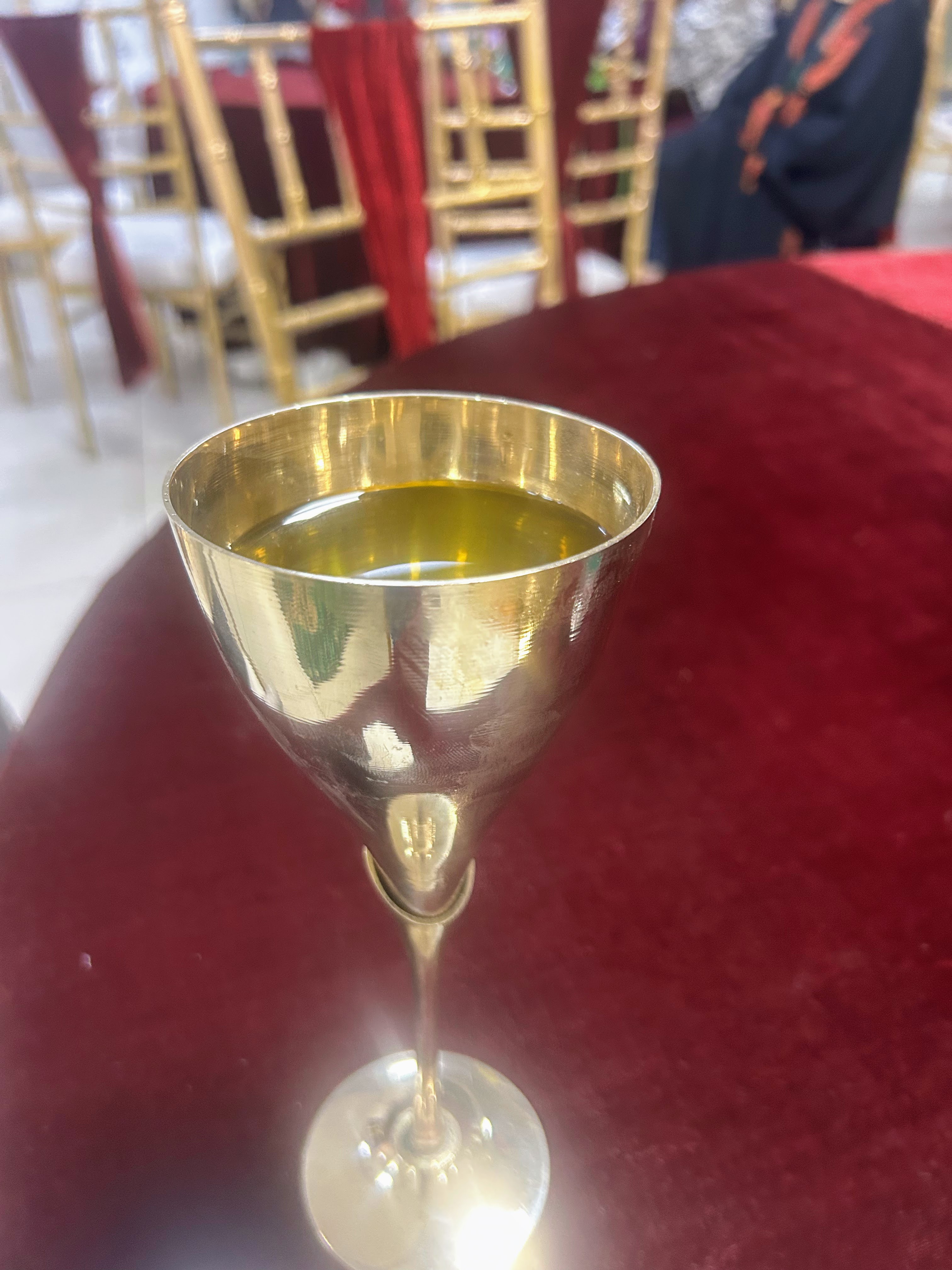
As stories and food memories began to flow, the first offering arrived: Khas Sherbet, served in an elegant brass glass. The conversation drifted towards community life—how there was once a time when we knew not just our next-door neighbours, but almost everyone on the lane. No one explicitly lamented how siloed life has become; it was simply understood. Perhaps the pace of life has changed, and gatherings like these are meant to be cherished when they happen.

Next came a Shami Kabab, delicately pounded on a sil batta, fibrous and soft. This was followed by Mutanjan, sweet rice garnished with almonds and sultanas, accompanied by the meat of teetar (quail). Chef Sadaf pointed out that in earlier times, “bird” almost always meant quail—never chicken. Chicken, he noted, became popular only after Partition.

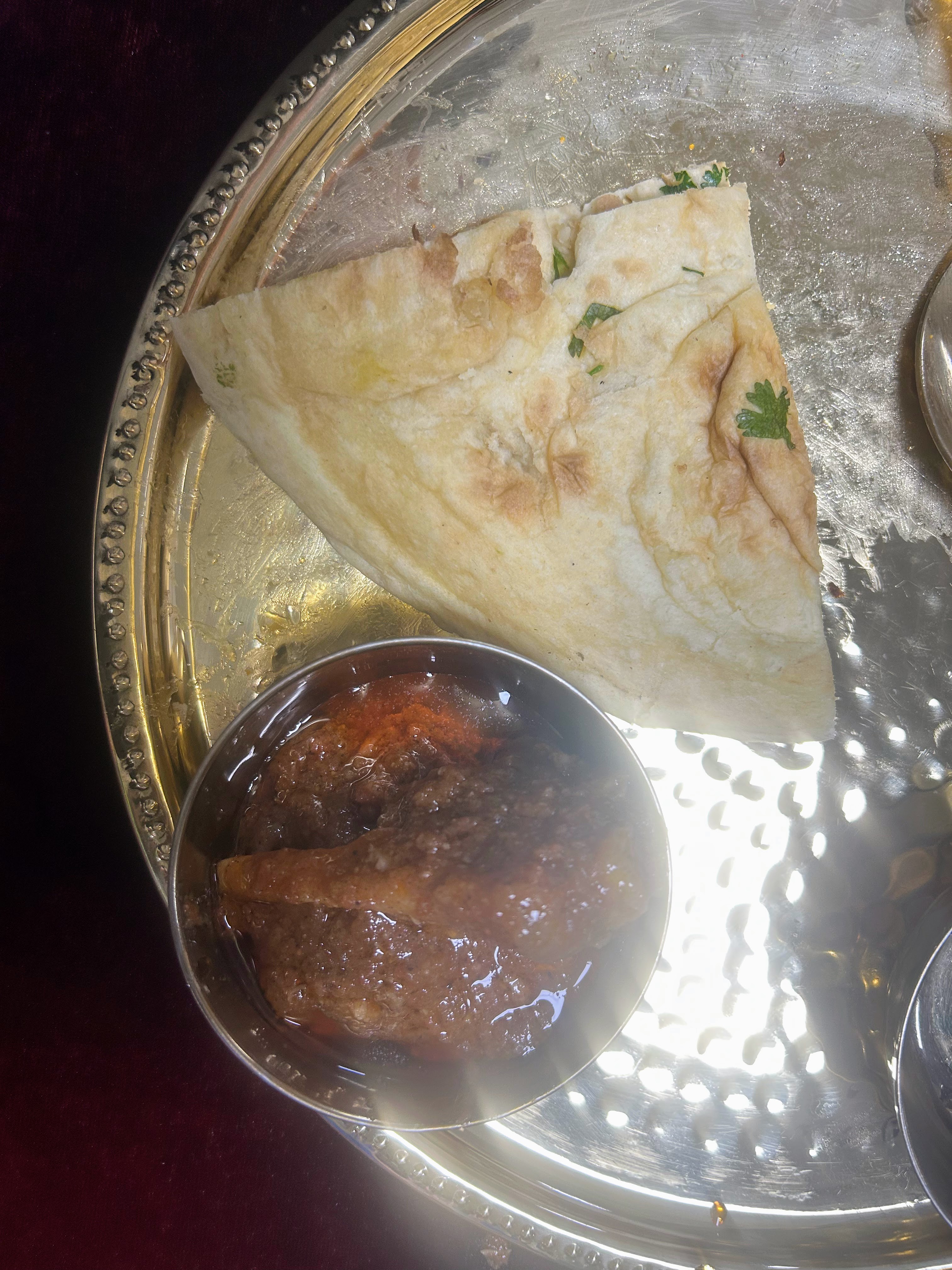
Then arrived the star of the evening: Nihari, served with Khamiri Roti—rich, slow-cooked, and deeply comforting. As we ate, memories surfaced of street vendors and their distinctive calls—jingles that once echoed through neighbourhoods. It wasn’t just food vendors; toy sellers, kulfiwalas, knife sharpeners, bangle sellers—all had their own sounds. With e-commerce and changing lifestyles, many of these have quietly faded away.

The next dish, Shab Deg—literally “cooked overnight”—arrived in beautiful brassware. Plates and bowls were wiped clean as we savoured yet another culinary tradition from Purani Dilli. Dessert followed: Mithi Roti with Kheer, the kheer cooked to a phirni-like consistency. Throughout, Chef Sadaf kept us enthralled—not just with flavours, but with stories of how dishes evolved and travelled through time.

The evening concluded with Meetha Paan, leading to a discussion on paan traditions across the country. While practices adapt to local tastes, we realised that their roots remain remarkably similar everywhere.

It was a near-perfect weekend—handicrafts, food, history, and a gathering of like-minded people. Sometimes, life introduces places to us in very specific ways. For me, The Kunj will always be associated with this evening—an experience that finally made missing the train worthwhile.

Guardians of Our Skies: Stories We Should Have Grown Up Knowing

We think we know what 21 looks like—restless energy, unfinished dreams, a horizon stretching endlessly ahead. I certainly believed that. But this Saturday, as I listened to the story of Flying Officer Nirmal Jit Singh Sekhon, I found myself quietly shaken. What does courage look like at 21? What does duty feel like when the cost is everything?

INTACH Delhi had announced a heritage walk at the Indian Air Force Museum, led by Retired Group Captain (Dr) Shajahan Avadi. It was curiosity that took me there. Only later did I realise how rare the opportunity was—the museum isn’t part of the usual tourist trail, and this was its very first heritage walk.

At the entrance, two things stood out. A crowd of schoolchildren—wide-eyed, excited—and at the gate, a real aircraft, standing like a guardian of memory. The walk leader began with a question: Why is a Gnat placed right at the entrance? Before we could think, an officer injured in service rolled past us in a wheelchair. The answer, perhaps, lay in the silence he left behind.

Inside, old photographs whispered forgotten stories. We heard of Indra Lal Roy, of “Jumbo” Mazumdar, of Sekhon—names that deserve far more space in our collective memory. The narrative unfolded like a tapestry: Dakotas landing in Srinagar in 1947, missions in 1965 and 1971, UN peacekeeping roles, and humanitarian operations during the Uttarakhand floods. These were not just stories of war—they were stories of service, endurance, and humanity.

Then came the aircraft displays. A Japanese kamikaze plane. A Pakistani Sabre shot down in 1971. And across from it, the small, almost fragile-looking Gnat. It was impossible not to imagine Sekhon climbing into it, fully aware that he may not return. The only Param Vir Chakra awardee of the Indian Air Force was just 21 years old.

For two hours, we walked, listened, absorbed. But more than the exhibits, it was the weight of the stories—the quiet bravery, the unspoken sacrifices—that stayed with me.

As I stepped out of the museum, a thought lingered: Why don’t we tell these stories more often? Why aren’t they part of every Indian child’s growing-up years? It was heartening to learn that the museum was in the process of moving to a larger building with more exhibits.

Maybe that morning didn’t just teach me history. Maybe it deepened my gratitude for the freedom I live so casually, so comfortably—freedom that someone, somewhere, once guarded with their life.

A Winter Walk Through Purani Dilli: Stories, Streets, and Subah ke Pakwan


With winter slowly tightening its grip on the city, I mentioned to a colleague last Friday that this year I wanted to finally try Daulat ki chaat. A fanatic Benarasi, she laughed and said, “You should go to Benaras and taste the better version.” Perhaps she wasn’t wrong—but Delhi, for all its culinary rivalries, is a food lover’s paradise. And winter? Winter is Delhi at its delicious best.

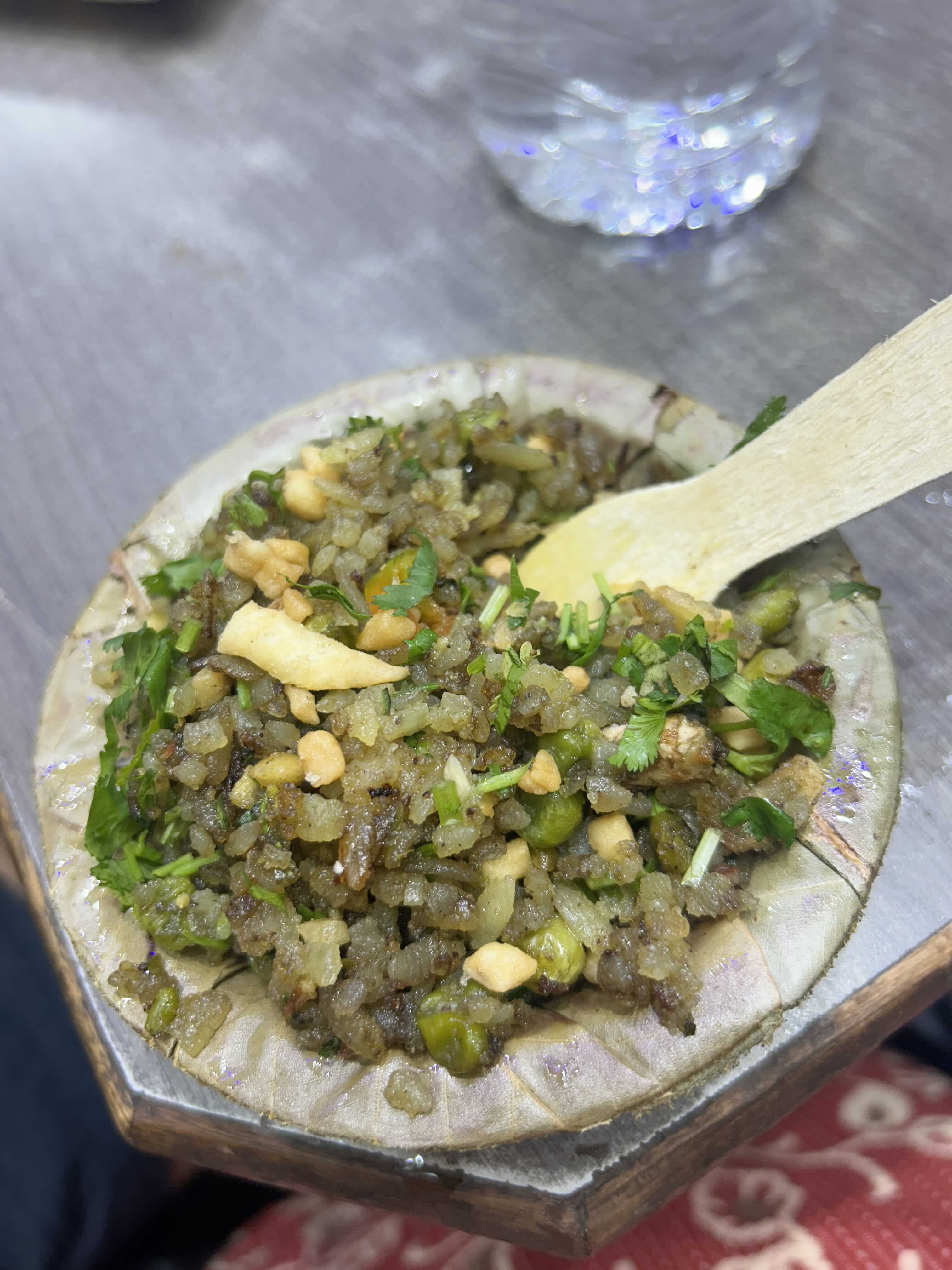
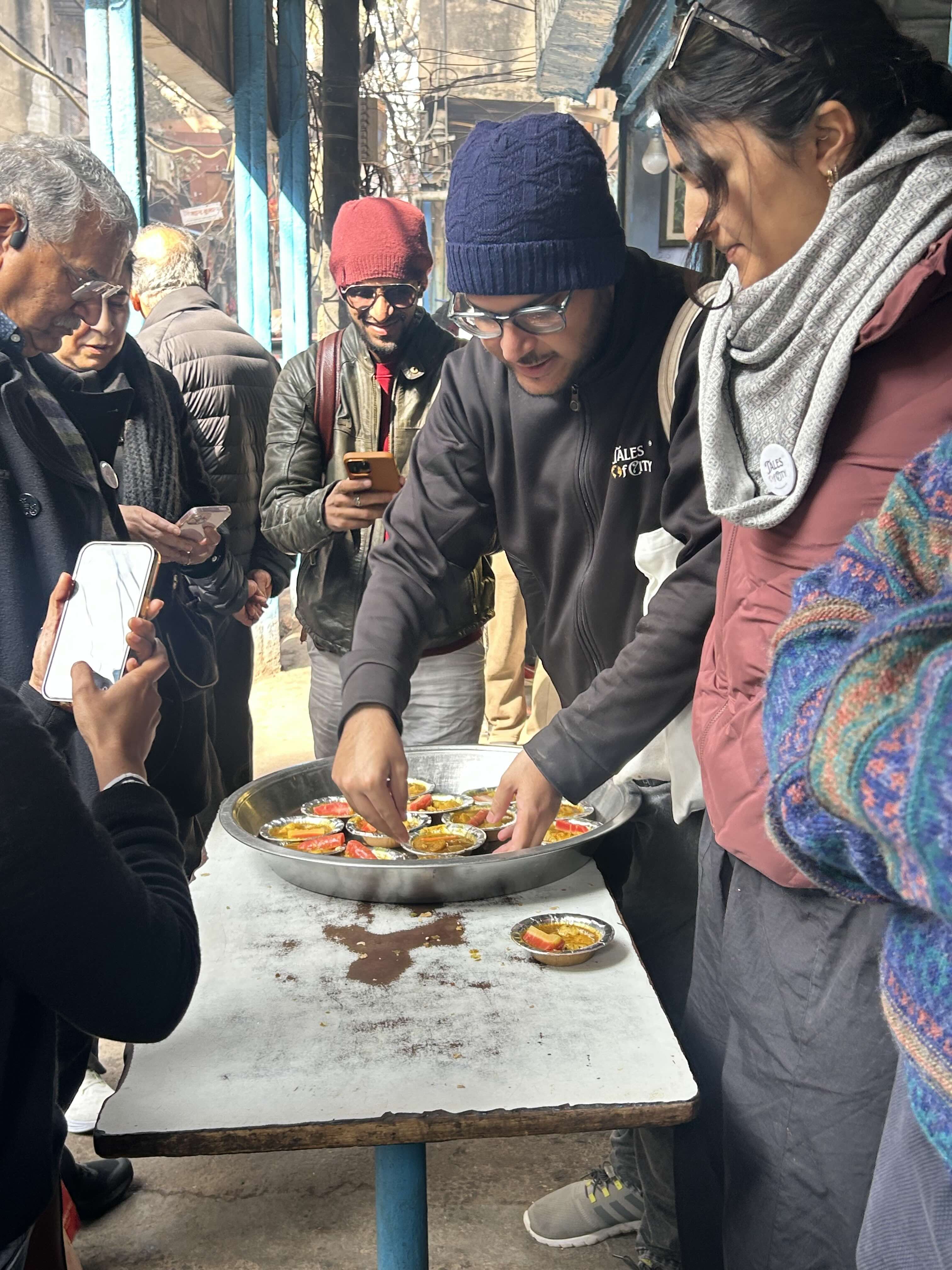
The chill in the air sharpens appetites and opens up the full spectrum of flavours: from savoury chaats to sinful ghee-soaked sweets. Amid it all, Purani Dilli holds a special place in every foodie’s heart. This Sunday, I joined a food walk titled Purani Dilli ke Subah ke Pakwan, curated by Tales of City and led by the knowledgeable Chef Sadaf Hussain. Like many, I associated Purani Dilli primarily with its legendary non-vegetarian fare.

The early-morning ride through its narrow lanes was surprisingly smooth—the city was still stretching awake. The walk began in front of Indraprastha Hindu Girls’ Senior Secondary School, the city’s first girls’ school, tucked behind Jama Masjid.

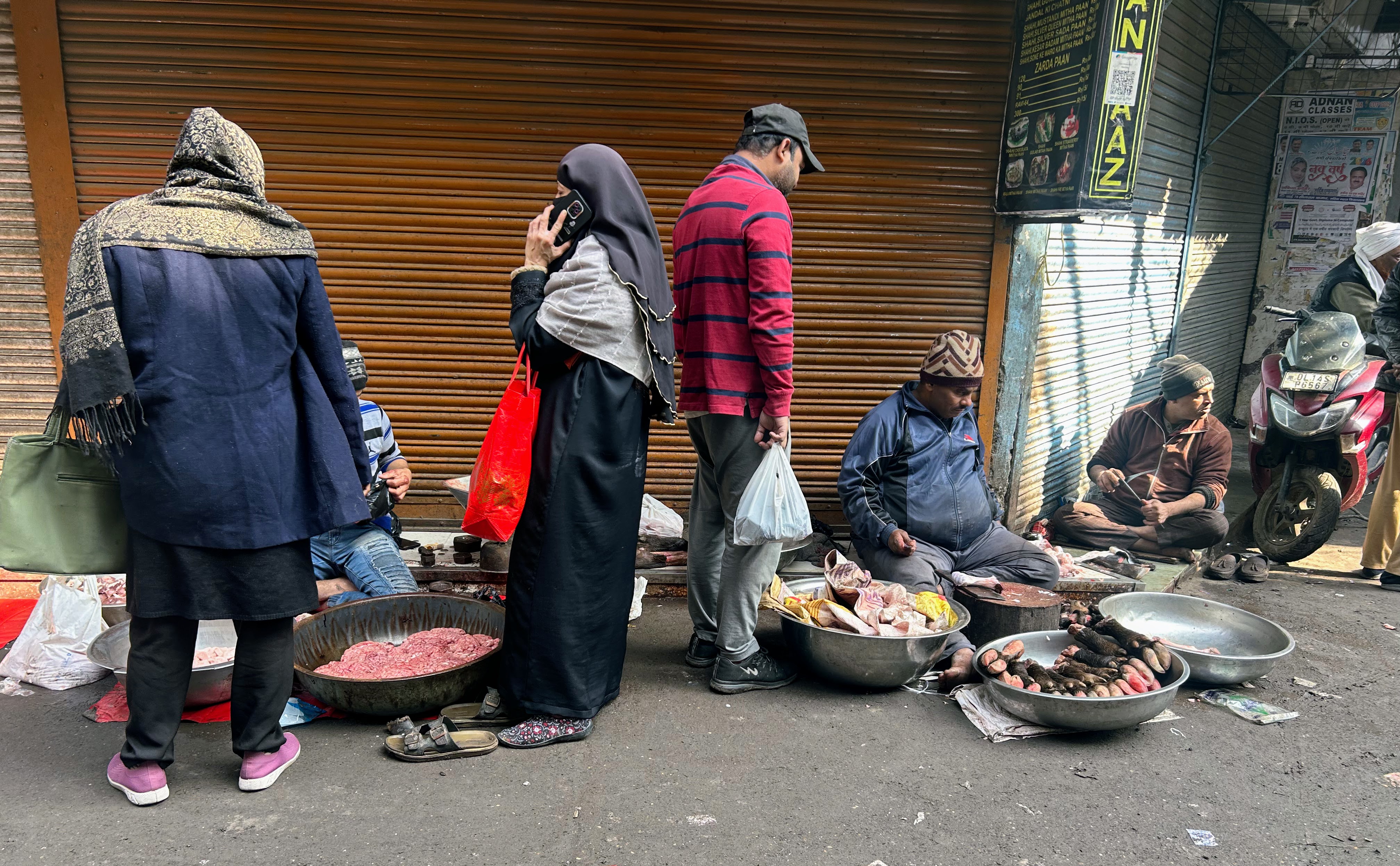
As we gathered, waiting for the walk to begin, I absorbed the scene around me: daily-wage earners cooking their modest meals, people taking their first sip of morning tea, a few men bathing by a tubewell, and roadside vendors quietly assembling their makeshift shops. Purani Dilli wakes up in chapters, each rooted in centuries of habit.

Once we set off, Chef Sadaf immediately challenged our assumptions. “This,” he announced, “will be a vegetarian food walk.” A ripple of surprise passed through the group.

Our first item was chai. I’m not a tea drinker—certainly not fond of roadside versions that lean heavily on sugar—yet this cup was surprisingly pleasant and perfectly sweet. Warm hands, warm cup, cold morning: Delhi in winter distilled into a moment.

As we walked, we learned how the old city once attracted people for their skills, leaving an imprint in street names that referenced professions long since faded. Navigating the tangled lanes—dodging bikes, scooters, rickshaws—was an adventure of its own. We passed doors that had obviously seen better days. The neighbourhood is a labyrinth where every turn looks like the last, except for the unmistakable pulse of life running through it.

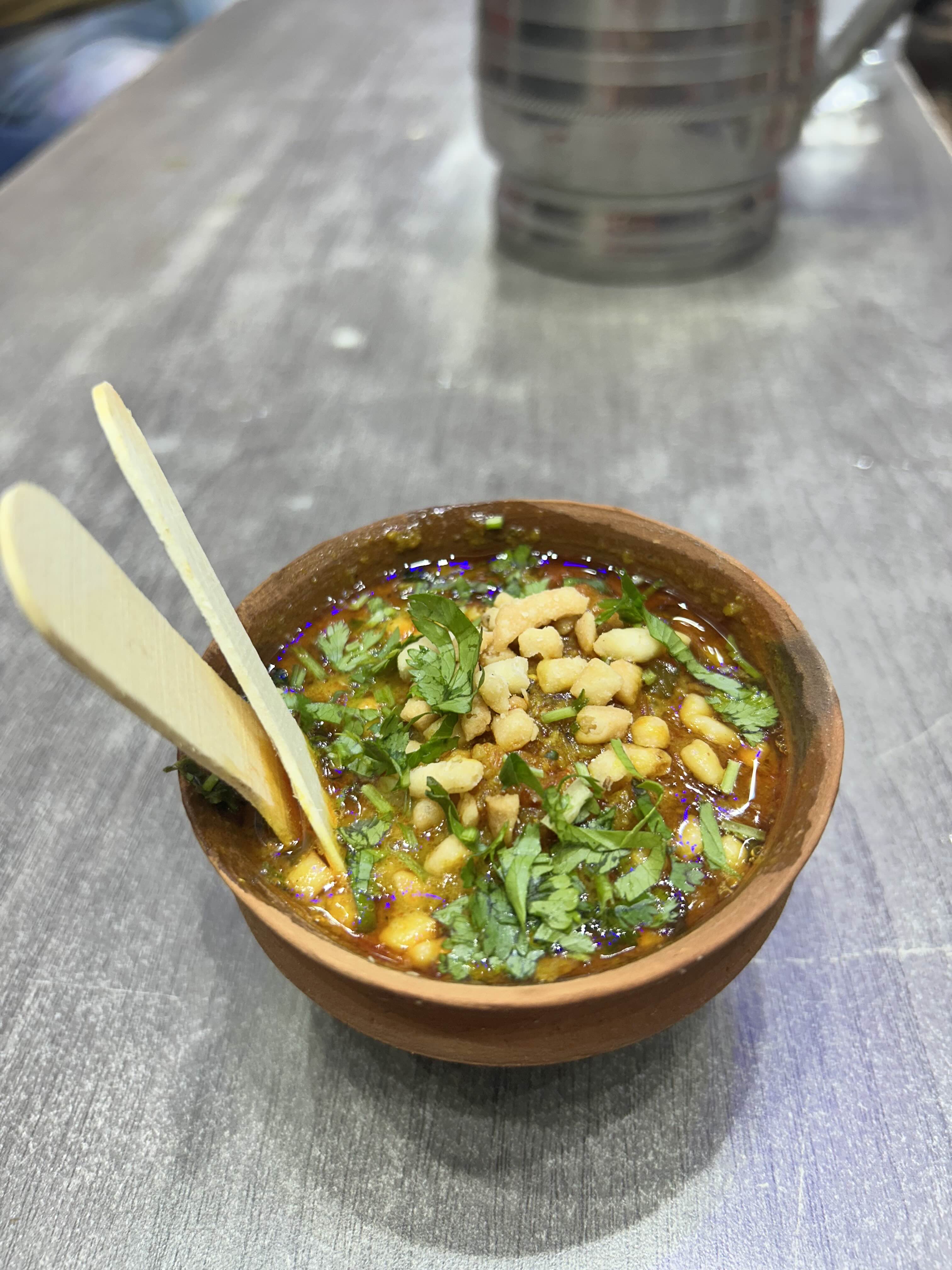
Our next destination was the famed Lotanji Cholewale. The shop, recently catapulted into mainstream fame after being invited to serve at the Ambani wedding, was buzzing with customers. The kulcha had a different texture than the ones I’d eaten before, while the chole was intensely flavourful. They serve three versions: less spicy, medium, and very spicy. We prudently stuck to the middle path.

As we dipped warm kulchas into spicy chole, perched precariously on the seat of a parked scooter, our group discussed breads—origins, variations, and adaptations—proving that food walks can easily turn into impromptu seminars.

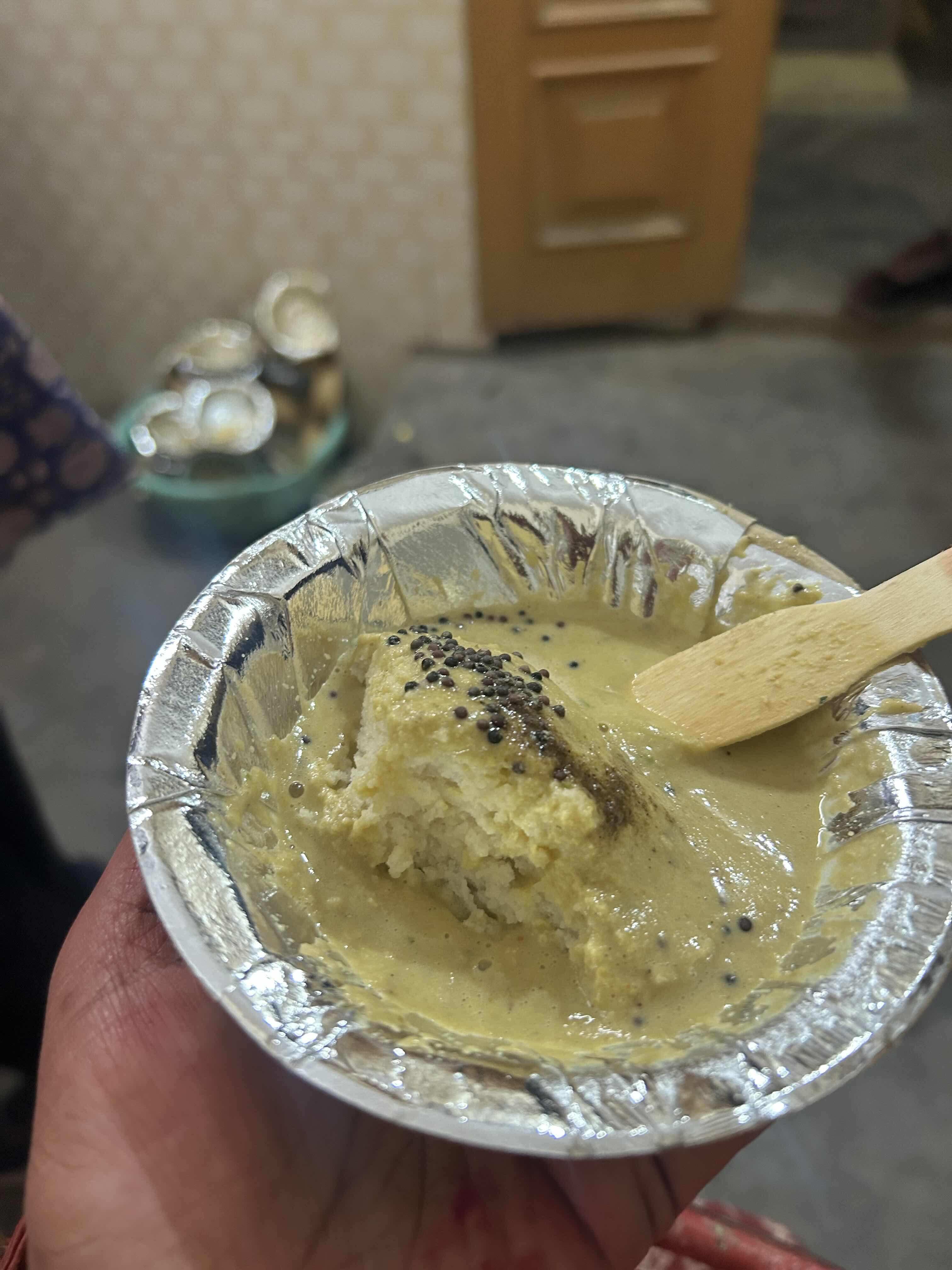
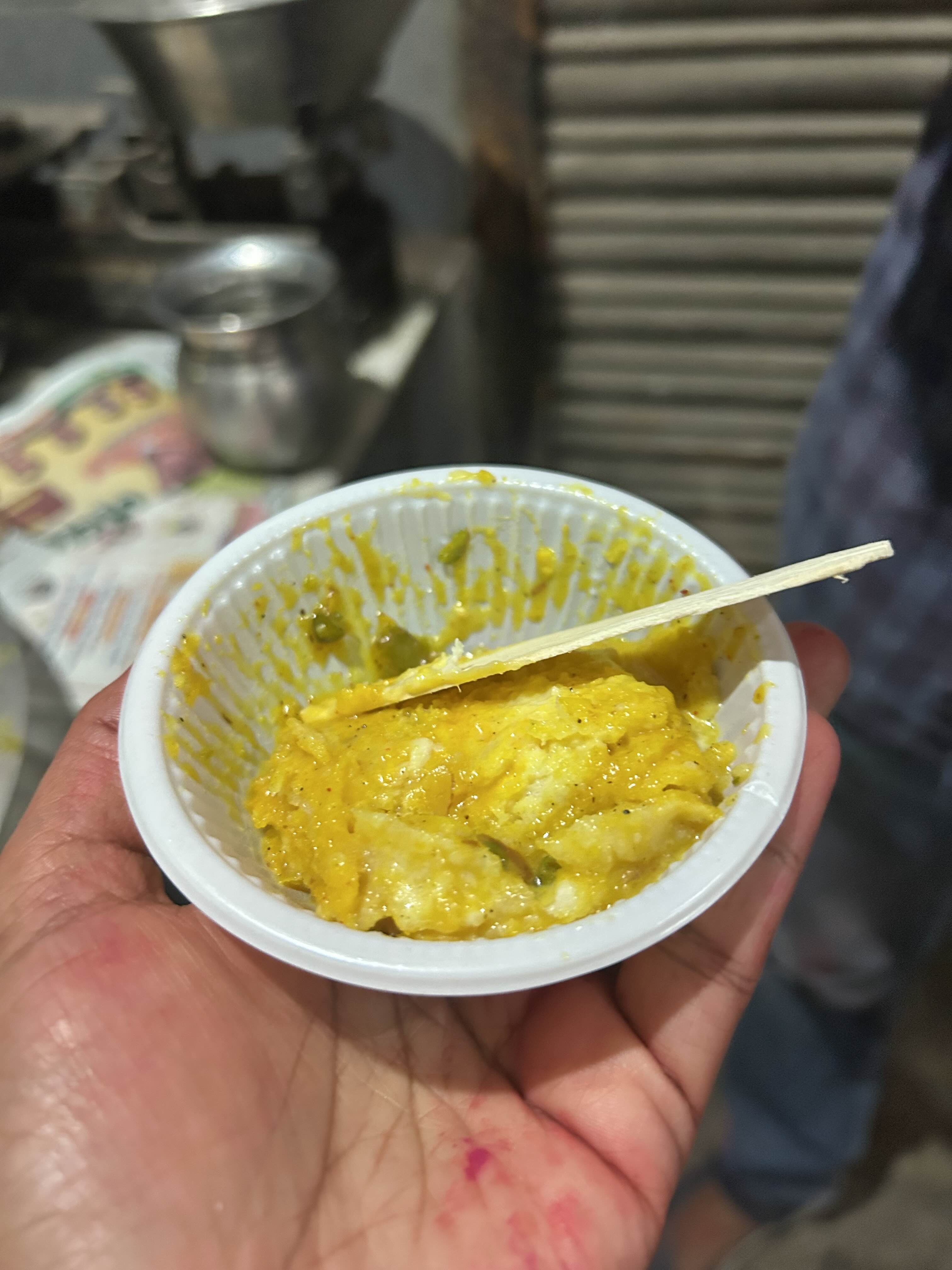
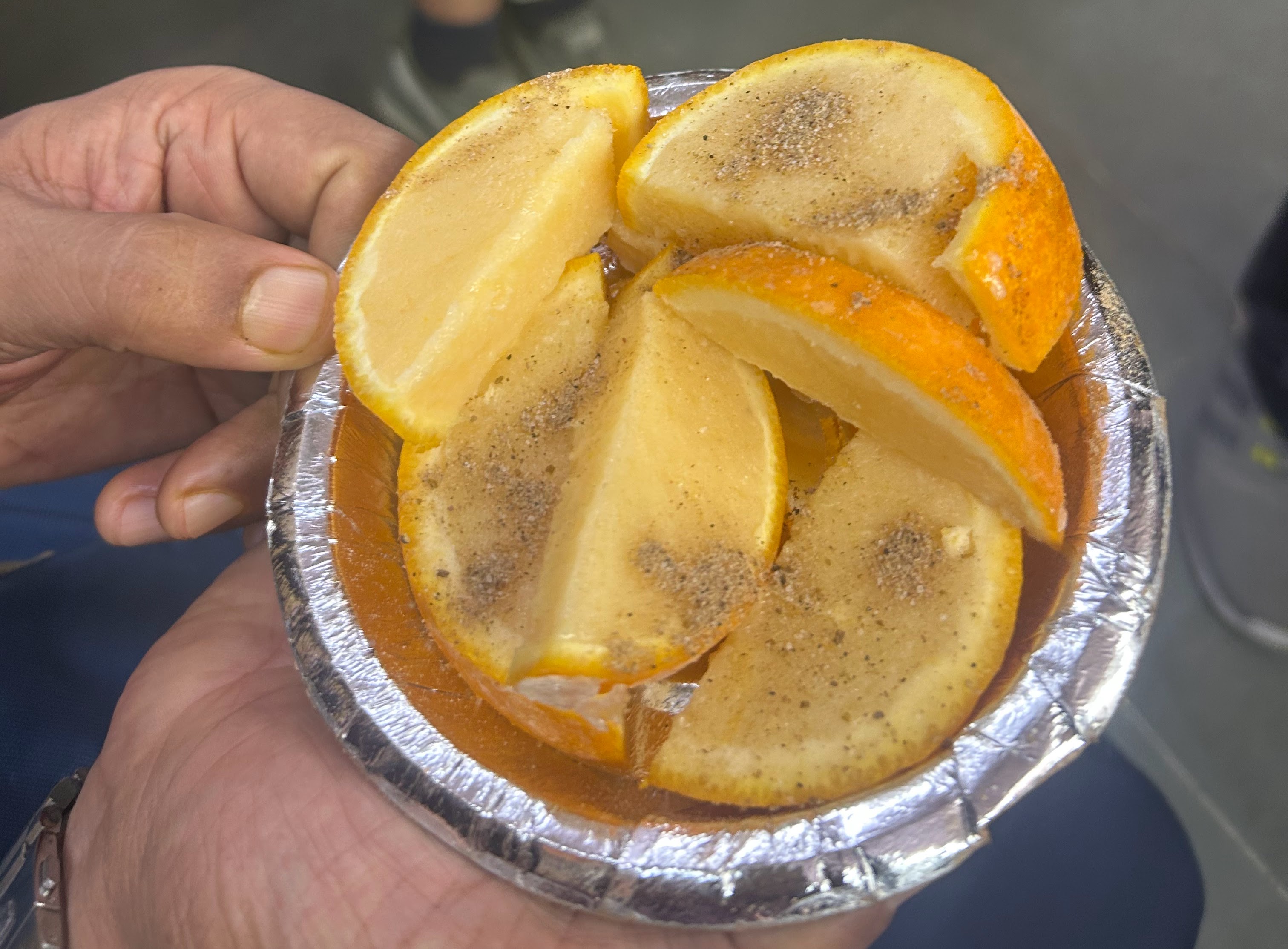
Then came the moment I was waiting for: Daulat ki chaat. I had only spoken about it two days earlier. Light, airy, delicately sweet—made from milk and winter air—it remains one of North India’s most magical seasonal desserts. I learned that its origins trace back to Afghanistan, and over time, it has woven itself into the culinary traditions of cities across northern India.

We emerged from the maze onto Chawri Bazaar—“Chawri”, from chawra, meaning “wide”. It may not appear wide today, but compared with the lanes we had just left, it certainly felt expansive. Here, we sampled warm nan khatai. I’ve eaten this crumbly cookie countless times, but never fresh off the tawa. Warm, fragrant, and gently melting—it was a revelation.

As we ate, life continued around us in its uniquely Purani Dilli way: a young girl performing acrobatics, a man getting his ears cleaned, people lining up for a shave and a massage. The old city compresses entire worlds into the width of a street.

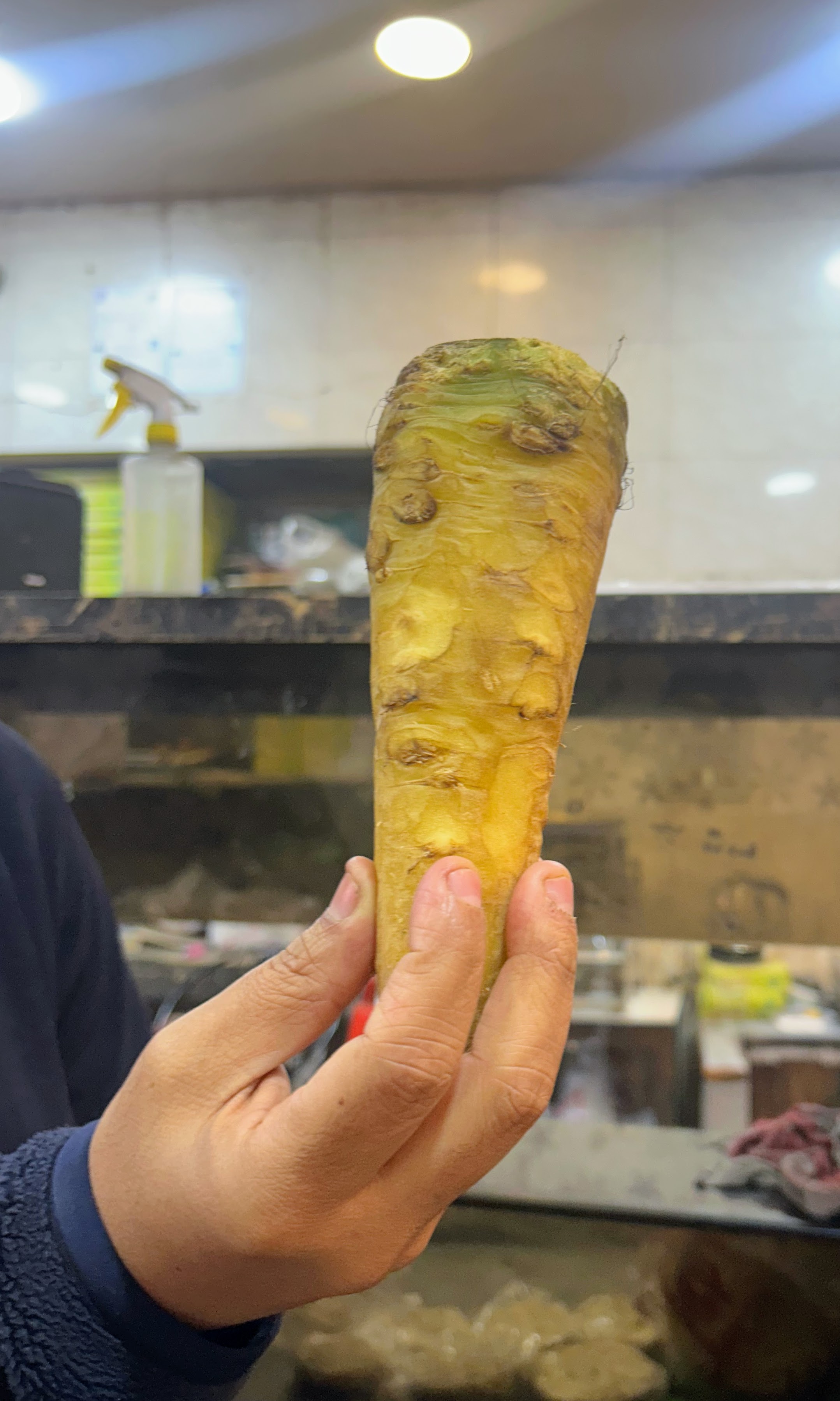
Next came Bedmi Puri with aloo ki sabzi and a pickled carrot. Piping hot, perfectly spiced, devoured instantly. We were told to save a spoonful of the aloo sabzi for the following item—Nagori Puri with halwa. Our walk leader then demonstrated a delightful trick: puncture the top of the Nagori puri, add the leftover aloo sabzi, and crown it with a generous spoon of halwa. A small act of alchemy.

Our morning ended at one of the city’s oldest kulfi shops. As we savoured our final treat—a Santara kulfi—I noticed a curious word painted on the board—Julpep. A blend of juice, lollipops, and popsicles. Who knows—perhaps someday it will find its way into a dictionary.

Satiated with food and stories, I realised something: it isn’t just the seven historic cities of Delhi that coexist—it’s the hundreds of culinary traditions layered across generations. Purani Dilli is not merely a place; it is a living archive of flavours, skills, and memories. Each lane carries stories, each shop an inheritance, each dish a fragment of Delhi’s ever-growing love affair with food.

A Walk Through Tughlaqabad: Heritage, Haze, and the Strange Comfort of Continuity

It was during a birthday celebration for a senior colleague that the conversation inevitably drifted to Delhi’s abysmal air quality. Amid complaints about AQI, someone turned to me and asked, “Aren’t you the one who posts about heritage walks in the city?” It was an amused, almost affectionate observation. The history enthusiast in me, forever trying to nudge colleagues into discovering the layered stories of Delhi, felt seen.

The next question followed immediately: “Are the walks held even in this pollution?”
I nodded. Yes. Many of them, I said, lead us to some of the city’s most extensive green patches, pockets of nature where Delhi briefly remembers the ecology that once supported its many empires.

Returning to Tughlaqabad

This weekend’s INTACH walk took me to Tughlaqabad, one of Delhi’s seven historical capitals. As I approached the massive fortifications, I found myself slipping back to another winter afternoon, possibly January 2006, when a friend and I first tried to explore Tughlaqabad. I had just bought my first car. We parked casually at the entrance and wandered inside, unaware of what awaited us.

The fort walls that day were crowded with groups of young men. There were no guards in sight. Two women alone in an unfamiliar, isolated space, we exchanged a brief glance, turned around, and left within minutes. That aborted visit stayed with me.

This time, everything was different. Surrounded by fellow history enthusiasts and led by the brilliant Ratnendu Ray, the experience was a complete reversal. We discussed everything from medieval weaponry to the economics of the 14th century, pausing often to take in the scale of Ghiyas-ud-Din Tughlaq’s vision.

Walls Built to Deter Eternity

The fort announces its presence long before you reach the gate. Even in their dilapidated state, the enormous stone walls, spanning over six kilometres in a half-hexagonal shape, retain a quiet arrogance. They were once meant to intimidate enemies, withstand sieges, and hold power. Today, they are softened by shrubs, wild grass, and the slow generosity of time.

We heard stories of the Tughlaq dynasty, of Ghiyas-ud-Din’s famously strained equation with the Sufi saint Nizamuddin Aulia, and the curse that supposedly doomed the fort soon after its completion. The palace area once had a deep baoli, a hamam, and a small mosque; the walk leader showed us older photographs, and it was sobering to see how much the site has eroded. Even thick, defiant walls cannot withstand the patience of centuries.

Haze Instead of History

We climbed to one of the highest points for a panoramic view of Adilabad Fort and Nai-ka-Kot. But all we could see was haze—Delhi’s new, stubborn skyline. Even the tomb of Ghiyas-ud-Din Tughlaq, barely across the road, was a ghostly silhouette.

On the way down, we wandered into a quiet corner where rocks lay piled along the fort wall beside a mound of used diyas. A local legend speaks of a pir, revered by both Hindus and Muslims. The fort may have been abandoned by royalty, historians, and tourists at various times, but the local community has gently folded it into their everyday spiritual landscape.

A Tomb in a Garden

Across the road, the ruler’s red-sandstone tomb sits inside an unexpectedly well-maintained, manicured patch of green. It also houses the tomb of a military commander named Zafar. With little historical detail available about him, we found ourselves imagining scenarios that could explain how a commander earned a resting place beside a king.

Driving Home With Impermanence

After more than three absorbing hours, as I drove away, a familiar thought settled in.

Empires rise, rulers command, forts stretch stone by stone toward the sky, and then, quietly, they collapse into stories, legends, and vegetation.

Power is temporary. Architecture is temporary. Even memory is temporary.

And yet, the act of walking through history, of witnessing its ruins with others who care, felt strangely grounding. In a city battling pollution, noise, and restlessness, these remnants remind us that everything is transient, but nothing is ever entirely lost.

Walking Through Memory: From Ugrasen ki Baoli to Jantar Mantar

It began, as many good things do, with a conversation over nostalgia.

About a month ago, a colleague who had started his career with me reminisced about our old office in Connaught Place, New Delhi. That memory sparked a half-hour exchange of stories — about coffees and milkshakes, thalis and biryanis, the food at various State Bhavans, and those impulsive lunch-hour shopping sojourns.

We were in our mid-twenties then, discovering what independence truly meant. So when an INTACH walk from Ugrasen ki Baoli to Jantar Mantar popped up in my WhatsApp feed, I knew I had to join. My first five years in Delhi — and at Connaught Place — had left me with some of my fondest memories. This walk, I thought, might help me know a little more about the city that once shaped my days. And with Ratnendu Ray leading it, there were bound to be stories worth walking for.


Setting Out

The email had advised us not to bring vehicles since the start and end points were different. But, true to my contrary instincts, I drove anyway. I parked opposite Barakhamba Road, found no attendant in sight, and left the car neatly in a corner so as not to inconvenience anyone.

It was a crisp morning, and I decided to walk to Hailey Road, where the Baoli stands. The roads were largely empty — the kind of quiet Delhi rarely offers. The footpaths were uneven, sometimes absent, sometimes grimy, but the city already felt alive in its own unhurried way.


The Baoli and Its Backstories

Nestled among high-rises, Ugrasen ki Baoli is remarkably well-maintained and ever popular with tourists. Our group gathered in the soft winter sun, listening to tales of Maharaja Agrasen, the Aggarwal Samaj, and the care of Delhi’s monuments.

As we left the site, someone asked who “Hailey” was — after whom the road was named. That led to the story of William Malcolm Hailey, Governor of Punjab and Delhi’s first Chief Commissioner. His work on the Jhelum Canal, which boosted agriculture in undivided Punjab, earned him a knighthood. Interestingly, what we now call Jim Corbett National Park was once Hailey National Park.

It struck me that the naming and renaming of roads — so often seen as a modern exercise — have always reflected changing eras and ideologies.


Glass Elevators and Forgotten Doors

Leaving Hailey’s history behind, we reached the Ambadeep Building — a striking landmark and the first in Delhi to feature external glass elevators. I must have passed it hundreds of times, marvelling at its mirrored façade, yet it was only today that I noticed its courtyards, terraces, and mosaic tiles.

A little ahead, as we turned toward Janpath, a locked old doorway caught our attention. Above it hung a faded board that read Martin Burn Limited. To most Bengalis, Martin Burn is synonymous with the construction of the iconic Howrah Bridge. What I hadn’t known was that the company was co-founded by Sir Rajendranath Mookerjee and Sir Thomas Acquin Martin — and that they chose the name “Martin” to sidestep the racial bias that Indian firms faced in securing British contracts.

Sometimes, the smallest details in a cityscape open windows to vast forgotten worlds.


Architecture, Emporiums, and Echoes of Communication

On Janpath stood Jawahar Vyapar Bhavan, home to the government emporium. I’ve always found the building intriguing, but I learnt that its design blends Japanese “Metabolism” architecture with Mughal influences — reflected in its material and rhythm.

Just ahead loomed the ageing MTNL building, its façade dulled by time, and in front of it, the bust of Rafi Ahmed Kidwai — India’s first Communications Minister. Today, when we take overnight deliveries and instant communication for granted, it’s easy to forget that Kidwai was the one who introduced night mail flights between Delhi, Mumbai, Kolkata, Chennai, and Nagpur — an innovation that once shrank the country’s distances.

Further down, Eastern Court stood in quiet resignation. Once, along with its twin Western Court, it had housed legislators. While the Western Court still serves as an MPs’ hostel, the Eastern Court was converted into offices for the Post and Telegraph Department. The building’s fading grace seemed to mirror the slow decline of the postal era itself — a reminder that communication, too, has its ruins.


Temples, Protests, and Time

Our next stop was a small, almost hidden temple of Batuk Bhairav, located behind Jantar Mantar. It once formed part of the same complex. We often forget that the land the British chose for their capital wasn’t empty — it was dotted with villages, shrines, and habitations. A sizeable portion belonged to the Maharaja of Jaipur, which is why this temple is still maintained by the Rajasthan government.

As we neared Jantar Mantar, the sound of chants grew louder. Protesters were gathered near the monument, many nibbling at roadside snacks between slogans. I’ve always wondered how this spot became India’s favourite protest site — perhaps that’s a story for another walk.


At Jantar Mantar — and Beyond

Jantar Mantar itself needs no introduction. The site, once neglected, was restored by the British. Its sandstone instruments, though outpaced by modern technology, remain astronomical marvels — precise, poetic, and quietly monumental.

The walk ended, but the city’s spell didn’t. I decided to take a slight detour to buy shoes. After trying several shops, I discovered that none had my size — everything was meant for larger feet.

So much for the saying, “Good things come in small packages.” The package, alas, still needs shoes.


Epilogue: The City as a Companion

Delhi often feels like a living palimpsest — each layer of its architecture, every old signboard, a trace of time refusing to fade. That morning’s walk wasn’t just a lesson in history or urban design; it was a quiet reminder of how cities hold our stories long after we’ve moved on.

Walking through Delhi, I wasn’t just revisiting its streets — I was revisiting myself, the twenty-something with coffee in hand and dreams in her eyes, finding independence one Connaught Place lunch break at a time.

When Maa Comes Home – Panchami

Durga Puja is special for every Bengali. But this year, it turned extra special. This year, Maa came home.

What does it feel like when Maa comes home?

It feels like months of planning and tons of shopping. It feels like chaos that somehow turns into joy. It feels like generations coming together—airport meetups filled with hugs, endless food, dressing up in silks and kurtas, and continuous adda sessions that carry through the night.

For me, Durga Puja has always been a community festival. My most vivid memory was from Kolkata, when our apartment complex organised the Puja—collective, chaotic, and deeply rooted in togetherness. I had only read about ghar-er pujo—Durga Pujas held at home—or seen them recreated in films. So when my cousin decided to organise one this year, I knew I had to be there.

And let me tell you, to call it “challenging” is an understatement. Durga Puja is often described as a Rajashik puja—one that kings performed. 

I woke up before dawn, caught connecting flights, and landed in the sweltering heat and humidity of Silchar. By evening, it was Panchami—the fifth day of Navratri—and time for the first ritual, Pran Pratishtha, the ceremony where life is invoked in the idol.

The evening was filled with frantic activity when a power cut threatened to plunge everything into darkness. Out came our mobile phones, lighting up the puja mandap in a glow both modern and makeshift. But Maa, it seemed, wasn’t amused by this arrangement. The power cut lingered, and finally, generators whirred to life, bathing the mandap in light once more. Just when we thought we would melt away in the humid heat, the electricity returned—as if Maa had decided it was time to ease our troubles.

And then it began. The sounds of the conch, ulu, and dhak filled the air, announcing what our hearts already knew—

Maa had come home.

Ridge of Resilience: Seeking Fresh Air in Delhi’s Living History

How is it that as technology advances, the quality of life seems to decline? This thought weighed heavily on my mind as I stepped out into Delhi’s smog-filled morning. Dull. Dreary. Suffocating. Each winter, the capital transforms into a gas chamber, and each year’s promises of cleaner air evaporate faster than the smog settles back in. With my quota of casual leaves exhausted, and thus, my dreams of a temporary escape, frustration clung to me like the haze itself.

Just then, a message flashed: an INTACH heritage walk in the Northern Ridge. A chance to breathe history, if not fresh air. That it was led by a master storyteller Ratnendu Ray, the idea was inviting. I signed up.

Sleep, however, conspired against me. I woke late, rushed through the morning, and hastened toward Kamla Nehru Ridge Park or Bonta Park, frantically searching for Gate No. 1. Inside, a short walk led to Flagstaff Tower, where the group awaited.

On the way, monkeys ambled fearlessly across the path as if they owned it. Morning walkers clutched sticks as insurance. Memories of Vrindavan’s notorious simian bandits resurfaced. Would my glasses survive this walk? But the monkeys only cast indifferent glances my way.


Where History Watches the City Below

The Northern Ridge rises above Shahjahanabad or Purani Dilli, one of Delhi’s seven historical cities. Flagstaff Tower, once a watchpoint, sits at its highest elevation. Today, it is surrounded by trees, but this greenery is not ancient; it is the product of three rounds of afforestation before independence. Hard to imagine that this tranquil patch of forest was once a British encampment during the 1857 war.

Our walk began with stories of the siege, of smoke and cannon fire, where parakeets now flutter, and a glimpse into early war journalism. Felice Beato, the pioneering war photographer, had captured this very landscape scorched by battle. The Delhi Urdu Akhbar had tried to shape public sentiment, reinforcing Bahadur Shah Zafar as the symbolic leader. The tools change, but the media’s role in nation-building and narratives remains constant.

We learned of Brigadier General John Nicholson, the strict Irish officer who commanded British forces from August 1857 till his death in September 1857. His reputation in the North-West Frontier was so imposing that he inspired a cult — his followers, the Nikal Seynis, treating him almost as divine. History has its ironic humour. Interestingly, the cult is said to have lasted into the 21st century.


Ruins, Remnants, and the People Who Remember

Next came Chauburji Masjid — a 13th-century mosque once crowned by four domes, now missing half its crown thanks to the bombardments of 1857. With its gates locked, we admired it from the outside. A group of elderly men paused their morning banter to offer us sweets and snacks. Their warmth cut through the wintry chill — and reminded me that heritage isn’t only stone and mortar, but memory and community.

At Pir Ghaib, originally Firoz Shah Tughlaq’s hunting lodge, a lone structure now stands beside Hindu Rao Hospital. A baoli lies neglected nearby. The mansion of Raja Hindu Rao, once a mighty noble’s residence, has vanished and today stands the hospital in its place. Has history been replaced by urgent modern needs? May be not. People who come to the hospital may not know him but his name carries on.

Near the Ashokan Pillar — fragmented by a 1713 East India Company ammunition dump explosion and later restored — the layers deepened. Mauryan ideals. Tughlaq’s passion for collectibles, Mughal drama. British intervention. Modern restoration. Delhi does not erase its history; it compacts it like geological strata.


A Victory Tower, A Shifted Narrative

We concluded at the Mutiny Memorial — a Gothic tower celebrating British “victory,” its plaques once labeling Indian freedom fighters as the enemy. After independence, a corrective marker was added: a reminder that the empire’s enemy was India’s fight for self.

Standing there, surrounded by green silence, I reflected on the three hours that had passed. My irritation from the morning now felt smaller. The air may be polluted, but the past here still breathes — vividly, defiantly.

Delhi’s history isn’t merely to be read in books. It rises from the earth, whispers through crumbling walls, lingers in the names of forgotten places. Technology may advance, and quality of life may falter — but what endures are stories. And on the Ridge, the city’s oldest stories still hold their ground.

The Taste of Traditions: A Thekua Story

This morning, I woke up to the crackle of crackers and devotional songs in praise of Chhathi Maiya from the temple next door. Coffee in hand, I watched from my balcony as families offered prayers to the Sun — a familiar scene that somehow always feels new. Later at work, a colleague pressed a small packet of thekuas and fruits into my hand. And as I took that first crunchy bite, I realized something: every year, without consciously seeking it out, I wait for the prasad of thekua. Chhath has always lived at the edges of my life — never my festival, yet always present in my world.

My earliest memory of Chhath is from childhood in Khonsa, Arunachal Pradesh. The town had just one river — a mountain stream that roared during monsoons but, for the rest of the year, became the gathering place for all rituals, from Durga visarjan to Chhath puja. An attendant in my father’s office, originally from Bihar, would bring prasad from the celebrations. His wife — a fierce, unlettered woman with big dreams for her four children — always saved a few extra thekuas for me. She called me “mamoni,” and that love tasted like jaggery and cardamom.

Silchar was different. Predominantly Bengali, yet home to enough Bihari families to light up the banks of the Barak River for Chhath. Some years, thekuas would find their way to our home; other years, the festival passed quietly. But the expectation never dimmed.

Then came work life — new cities, new colleagues, and the same familiar warmth. Wherever I’ve gone, someone celebrating Chhath has always remembered how much I love thekuas. And so, the tradition continues: a festival not mine by birthright, but one claimed through affection, generosity, and food.

It fascinates me how food connects us to cultures beyond our own. Onam isn’t a Bengali festival either, but the joy of a sadya has made it mine. My years in Mumbai sealed my lifelong devotion to modaks during Ganesh Puja. Perhaps that’s the beauty of living in many places — we inherit new traditions not through rituals, but through taste.

Some festivals we are born into. Others adopt us quietly — one delicious thekua at a time.

Through the Sacred Corridors of Mathura and Vrindavan

Day two of my sudden visit to Vrindavan began early. I wanted to make the most of the morning calm and planned to cover Mathura before the crowds swelled. The lanes grew narrower as I neared the Krishna Janmabhumi Temple — ancient walls closing in on centuries of devotion. A man pointed me toward a parking spot and casually suggested taking a guide who, he promised, would show me not just the temple but also Gokul. I agreed.

At the entrance, I had to surrender my bag and all electronic devices. The security rule was firm: no cameras, no phones — no distractions. As I stepped inside, I noticed the resident monkeys, confident and curious. I tightened my grip on my glasses, prompting my guide to chuckle, “Vrindavan ke bandar padhe likhe hain” — the monkeys of Vrindavan are educated; so they snatch glasses!

The temple complex opened into the garbha griha, the Yogmaya Mandir, and finally the Bhagvad Bhawan, where the main idols of Radha and Krishna are enshrined. My early start paid off — I reached just in time for the Mangal Aarti, the first offering of the day that wakes the deity. The chants, the incense, and flickering lamps created a rhythm that seemed to dissolve the boundary between ritual and reverence.

As I stepped out, the domes of the Shahi Idgah Mosque gleamed across the complex — a reminder that Mathura’s story, like India’s, is layered with shared histories.


Across the Yamuna: Gokul’s Cradle of Legends

Though my next stop was supposed to be the Dwarkadhish Temple, my guide gently reminded me of my promise to visit Gokul. We crossed the Yamuna — that mythical river Vasudev once forded on a stormy night carrying baby Krishna.

Gokul’s lanes were humble yet alive with myth. The centerpiece, Shri Nand Mahal, stood adorned with vibrant murals and a cradle for little Krishna. Watching people do so with gentle reverence made the mythology come alive in the most tender, human way.


Dwarkadhish Temple and the Call of Vishram Ghat

Back in Mathura, the Dwarkadhish Temple awaited at the end of another labyrinth of lanes. A rickshaw helped me glide through the festive chaos — Diwali shoppers, sweet sellers, and vendors adding color to the air. Inside the temple, serenity prevailed. I had a clear darshan of the idol and a brief, grounding silence amid the bustle.

Just a few steps away lay Vishram Ghat, the sacred stretch where Krishna is believed to have rested after slaying Kansa. My guide seemed mildly disappointed when I declined a puja, preferring instead to watch life unfold — priests lighting lamps, pilgrims taking a dip in the Yamuna, and boats plying. When I pulled out my phone for a photo, he sighed, “Aajkal sab picnic ban gaya hai.” I smiled quietly and said nothing. Sometimes, observation is devotion too.


Vrindavan Again: The Marble Glow of Prem Mandir

By afternoon, I was back in Vrindavan. The crowd at Prem Mandir looked overwhelming, but curiosity won. The line for women moved swiftly, and within minutes I stood inside a vast marble complex where devotion and architecture met in perfect harmony. Tableaux from Krishna’s life lined the approach to the temple — scenes from Govardhan, Rasleela, and Kaliya Mardan — each carved in intricate detail. The crowd no longer felt like a crowd; it felt like community.


The Curtain Falls at Banke Bihari Temple

My final stop was the Banke Bihari Temple, where the playful aspect of Krishna is worshipped. The idol, believed to have appeared in Nidhivan, is known to be so charming that the priests periodically draw a curtain — lest devotees lose themselves in his gaze.

Navigating the lanes took effort, and I nearly lost my way back, mistaking one identical shop for another while trying to retrieve my juttis. The small confusion felt fitting for Vrindavan — a town where divine playfulness extends even into mundane moments.


Evening Reflections: A City That Chooses You

As I walked back, the sound of kirtans filled the streets. Monks from ISKCON sang “Hare Krishna” in unison, their cymbals echoing through the festive air. Shops and homes glittered in Diwali lights, and everyone greeted one another with a gentle “Radhe Radhe.”

Some places you plan to visit; others seem to summon you. Vrindavan, I realised, had chosen me for this long weekend — to remind me that faith isn’t always about ritual. Sometimes, it’s about rhythm, stillness, and surrender in a place where every corner hums with devotion.


A road trip to Vrindavan: Of Chance Journeys and Quiet Realisations

Do places choose us, or do we choose them? I’m not a psychic, but that question kept circling in my mind as I drove down to Vrindavan. I am not someone who visits temples often—especially the crowded ones that feel more like fairs than places of prayer. So, why was I headed there?

Diwali falls on Monday this year, making it a long weekend. Having just returned from a Durga Puja break, I had no plans. But as friends and colleagues began sharing theirs, the idea of doing something started tugging at me. I almost decided on Benaras, until I realized that if I went there, I would have to travel on Diwali day just to reach the office by Tuesday. That didn’t feel right.

And so, without much deliberation, the plan seemed to make itself. Saturday morning, coffee in hand, I casually searched for short drives from Delhi—and just like that, Vrindavan and Mathura appeared on my screen. A few clicks later, the hotel was booked. By Sunday morning, I was on the road.

Leaving Delhi and Gurugram behind, I cruised along the Delhi–Vadodara–Mumbai Expressway before turning onto the Western Peripheral Expressway and then NH44. The road stretched out smooth and bright, flanked by bursts of bougainvillea in pink and orange. There was even a man with his pet monkey performing tricks by the roadside. The blanket-sellers confirmed what I already felt in the breeze—that summer had finally loosened its grip.

Less than three hours later, I reached Vrindavan. My first greeting: “Radhe Radhe.” Here, Krishna is not just worshipped—He is woven into every breath, every sound, every conversation.

After a short rest, I took an e-rickshaw to explore. My first stop was the ISKCON temple. Before I got down, the driver advised me to remove my glasses—Vrindavan’s monkeys, he warned, were expert snatchers. As if to prove his point, one sat nearby watching me intently. I quickly slipped my glasses into my purse—a precaution that became routine for the rest of the day.

From ISKCON, I headed toward Kesi Ghat, stopping at Nidhivan on the way.

According to legend, Nidhivan is where Lord Krishna performs his Raas Leela with Radha each night, which is why the grove is closed to visitors after dusk. It is said to hold 16,000 kinds of tulsi plants. My rickshaw driver suggested hiring a guide, but I declined—only to find one walking beside me moments later. After some friendly persuasion, I agreed, and I’m glad I did; the lanes were narrow, winding, and easy to get lost in.

The guide led me through a series of small temples, each echoing with the soft rhythm of bells and chants. One was dedicated to Swami Haridas, a revered devotee of Krishna. By the time we reached there, I had run out of small notes. When I offered a hundred-rupee note instead, the priest smiled and handed me not only charanamrit but also a besan laddoo. I couldn’t help but laugh as I walked away, nibbling on the sweet.

Another memorable stop was the Vrindavan Bihari Dauji Maharaj Temple, its walls covered with marble plaques dedicated by devotees—including one from Lalu Prasad Yadav and Rabri Devi.

As evening approached, I made my way to Kesi Ghat. I’ve always known the Yamuna as a polluted river, so it was a pleasant surprise to see it in better shape. The sky glowed gold and lilac as people around me floated tiny diyas in the water. I joined them, releasing one that drifted gently downstream—a small offering of light.

Nearby, preparations were on for the Sandhya Aarti. I waited for over an hour, watching lamps being arranged, the air thick with anticipation. At one point, the priest scolded a woman for using a plastic plate under her diya. “If we think only of faith and not of nature,” he said, “then our prayers will bear no fruit.” His words struck me as profoundly true—for perhaps that’s the only way India’s rivers can be saved.

After another half hour of waiting, the Aarti still hadn’t begun, and I finally decided to return.

On the way back, the soundscape of Vrindavan surrounded me—kirtans from nearby temples, devotees quietly counting rosaries as they walked, and everywhere, the soft greeting of “Radhe Radhe.”

In that moment, I realized: perhaps we don’t choose places. Maybe they choose us when we need them most.