
Delhi doesn’t reveal itself all at once. It unspools in layers — a whisper here, a ruin there, a breeze carrying the scent of marigolds and memory. On a quiet Sunday morning, I joined a heritage walk curated by Enroute Indian History, tracing the sacred and ceremonial path of Phoolwalon ki Sair — the annual festival of flowers, peace, and communal harmony held in Mehrauli.
But what I encountered was far more than just a trail of rituals — it was a journey through the soul of Delhi.
Where the City Began: Yogmaya Temple
Our walk began at the Yogmaya Temple, one of the few surviving temples from ancient Delhi and possibly as old as the city itself. It stands tucked away in the heart of Mehrauli, quiet yet powerful, like the still eye of a storm that has raged for centuries around it.

Long before Mehrauli acquired its present name, the area was known as Yoginipur — the city of yoginis. The temple, dedicated to Goddess Yogmaya (a sister of Krishna in mythology), still plays a central role during Phoolwalon ki Sair, with floral offerings made here alongside those at the nearby Dargah. As we stood beneath the age-worn arches, time itself seemed to slow down.

A Tomb with a Curse: Adam Khan’s Memorial
Not far from the temple, we made a detour to the tomb of Adam Khan, a monument steeped in local lore. Adam Khan, the foster brother of Akbar, was executed for treason, flung twice from the ramparts of Agra Fort to ensure death.
His tomb stands out for its Indo-Islamic architecture, reminiscent of Delhi Sultanate-era design rather than typical Mughal grandeur. It is said that no local woman of Mehrauli visits the tomb, believing it to be cursed. The only women who do are usually tourists or history students, like us. The air around the tomb is oddly heavy — less reverence, more caution.

A Sacred Journey: Dargah of Khwaja Bakhtiyar Kaki
We then followed the festival’s spiritual trail to the Dargah of Khwaja Bakhtiyar Kaki, the 13th-century Sufi saint and disciple of Khwaja Moinuddin Chishti of Ajmer. A contemporary of Sultan Iltutmish, Kaki is revered as one of Delhi’s patron saints, and his shrine continues to draw pilgrims, politicians, and poets.
It is said that every ruler of Delhi sought the blessings of Sufi saints to gain legitimacy, and this Dargah, in particular, carries that aura of sanctified power.
As we stepped inside the whitewashed courtyard, a qawwal seated by the gateway began to sing. His voice, deep and raw, cut through the morning stillness, carrying the lyrics of Chaap Tilak. The Dargah came alive — not with grandeur, but with music, faith, and centuries of longing.
A Forgotten Well of Healing: Gandak ki Bawli
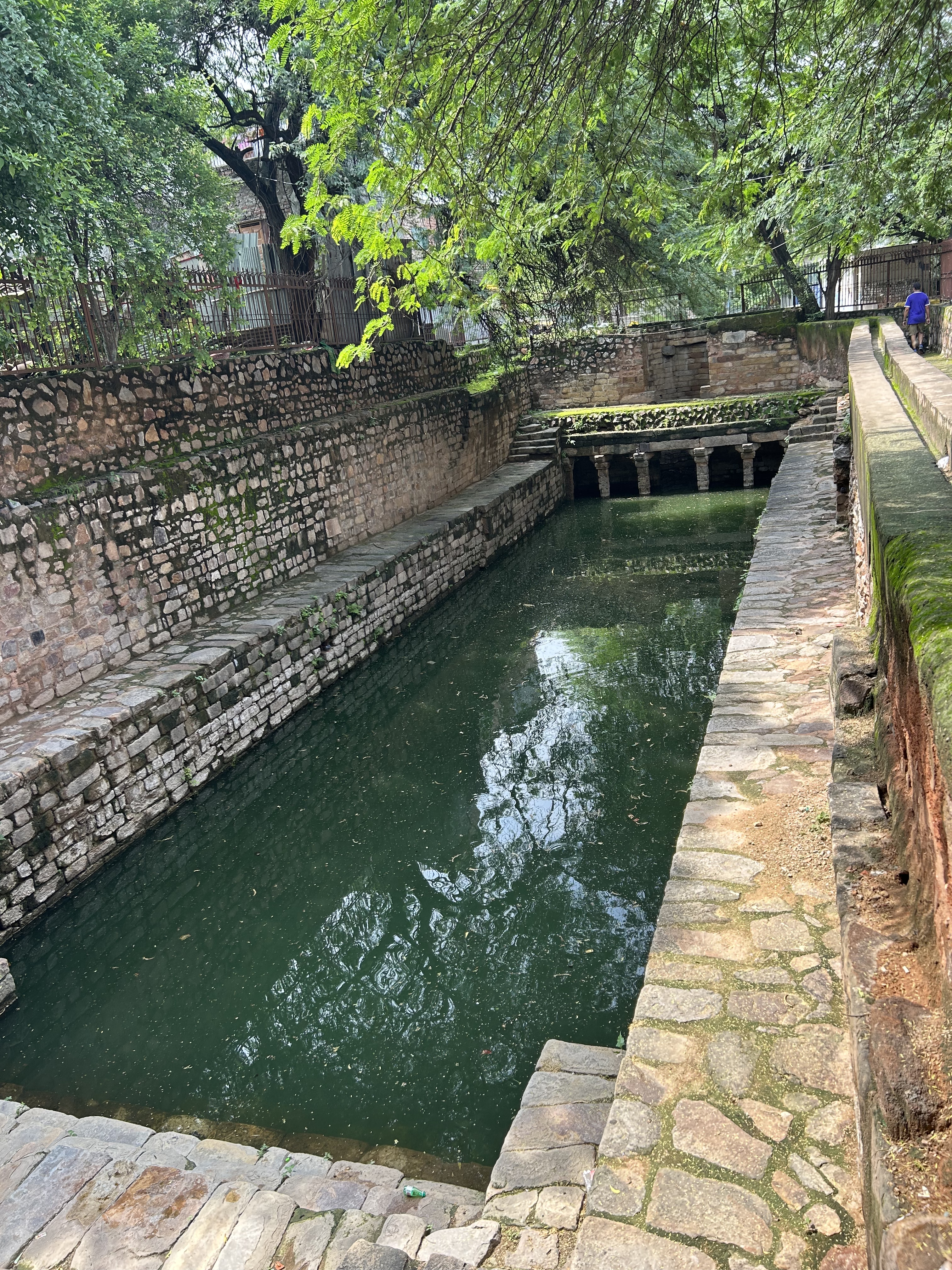
On the way to the Dargah, we stopped at the near-forgotten Gandak ki Bawli — a stepwell slowly sinking into neglect, yet once central to local life. Gifted by Iltutmish to the Dargah, the stepwell was believed to possess healing powers, and pilgrims would take a dip in its waters before offering prayers.
Later studies revealed the water had a high sulphur content, lending some scientific basis to the belief that it could cure skin ailments and other illnesses. Today, the water is stagnant, the steps cracked, but the legend still lingers — like a half-remembered dream.

Where the Empire Withered: Zafar Mahal
The final stop of our walk was the Zafar Mahal, the summer residence of Bahadur Shah Zafar, Delhi’s last Mughal emperor. Mehrauli, cooler than the rest of Delhi due to its elevation and greenery, became the seasonal retreat of the royal court. And this retreat wasn’t symbolic — the emperor moved with his whole retinue, even shifting the throne to Mehrauli for the duration.
Inside the Mahal is the Moti Masjid, a private prayer space built by Zafar himself. But the site is not just a reminder of royal solitude — it is also the stage for a powerful piece of local lore.

People in Mehrauli still say that the proximity of Zafar Mahal to the Dargah was a fateful misstep. “Sufi badshah se bada hota hai,” they say — a Sufi saint is greater than a king. Perhaps it was no coincidence, they whisper, that the Mughal Empire collapsed soon after. Bahadur Shah Zafar, the poet-emperor, would eventually die in exile, far from his beloved Delhi, and never be laid to rest in the tomb he had built for himself beside the Dargah.
A City of Shadows and Fragrance
As I walked back through Mehrauli’s bylanes, the scent of mogra, the hum of old qawwalis, and the echoes of royal processions accompanied me. Delhi, I realized, isn’t just a city of monuments — it is a city of memory, myth, and mood. Every stone here remembers. Every shrine still breathes.
Phoolwalon ki Sair may be celebrated once a year, but the path it takes is eternal — a living map of Delhi’s soul, etched in fragrance, footsteps, and faith.
 Jajabor